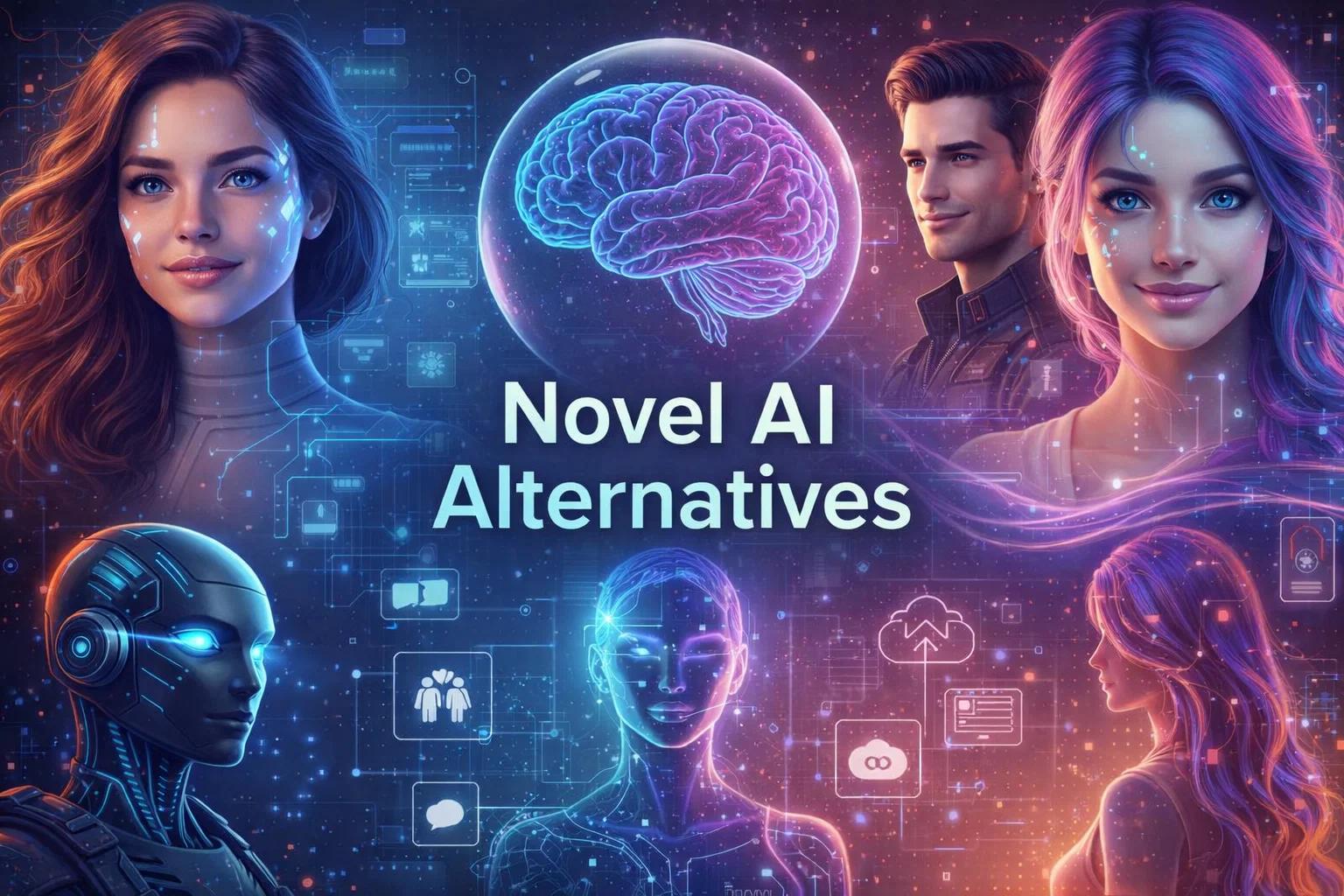
Let’s be real, people don’t go looking for NovelAI alternatives because everything’s perfect. Usually, it’s the opposite. You hit a limit, get bored with the tone, or just start wondering… what else is out there?
And there’s a lot out there. Some tools feel more unfiltered, some are surprisingly emotional, and a few lean into that slightly addictive “just one more message” kind of energy. Different platforms bring different moods, from soft storytelling to chaotic roleplay to stuff that sits right on the edge of what you’d expect from an AI.
This isn’t about ranking them or telling you what to pick. It’s more like opening the door and letting you peek inside – a mix of popular names and under-the-radar options, each with its own flavor, quirks, and level of… freedom.
1. Cherrypop.ai
We created Cherrypop.ai as a platform centered around interactive AI characters and ongoing conversations that feel more dynamic than static text generation. For users exploring NovelAI alternatives, it often comes up in a slightly different context, since the platform is built around the idea of chatting with AI personalities that feel responsive and adjustable, rather than just generating text in isolation. The focus is on giving users space to explore different tones of interaction, whether that leans toward casual conversation, roleplay, or more open-ended scenarios.
Our platform revolves around a large library of user-generated and prebuilt characters, each with distinct traits, backstories, and conversational styles. Alongside that, there are tools to create and customize your own characters, shaping how they respond and evolve over time. Compared to traditional storytelling tools, the experience here feels more like stepping into a conversation than writing a structured narrative, which puts it in a slightly different category among NovelAI alternatives.
Key Highlights:
- Character-based interaction instead of traditional text generation
- Large library of prebuilt personalities with different themes and tones
- Custom character creation with adjustable traits and behavior
- Conversations that adapt over time based on user input
- Option for more open or less restricted dialogue styles
- Includes image and content generation features alongside chat
Who It’s Best For:
- Users exploring roleplay-style AI experiences beyond classic NovelAI alternatives
- People who prefer interactive chat over structured writing
- Those looking for more flexibility in tone and conversation boundaries
- Creators interested in building and testing custom AI personalities
- Anyone curious about tools that feel less like a writing system and more like a companion-style experience
Contact Information:
- Website: cherrypop.ai
- Email: [email protected]
- Address: 1209 Mountain Road Pl NE #7596, Albuquerque, NM 87110, USA

2. Candy.ai
Candy.ai shows up in the NovelAI alternatives space as something that leans more into ongoing interaction than classic text generation. The platform is built around AI companions that respond across chat, voice, images, and even video, so the experience feels closer to maintaining a conversation than writing a story from scratch. It’s not really about structured storytelling – it’s more about continuity, memory, and how the interaction evolves over time.
There’s a noticeable focus on personalization. Users can shape characters visually and behaviorally, then continue developing them through repeated interaction. The system tracks preferences and adjusts tone, which shifts the experience away from one-off prompts toward something more persistent. Compared to tools focused purely on writing, this sits somewhere between roleplay and conversational simulation.
Key Highlights:
- AI companions with chat, voice, image, and video interaction
- Character customization across appearance and personality
- Memory system that adapts responses over time
- Mix of prebuilt characters and user-created ones
- Ongoing interaction instead of one-time text output
Who It’s Best For:
- Users who want continuous interaction instead of static writing
- People exploring AI roleplay with more personal input
- Those interested in voice and visual elements alongside chat
- Anyone looking for a more conversational format
Contact Information:
- Website: candy.ai
- Facebook: www.facebook.com/trycandyai
- Twitter: x.com/trycandyai
- Instagram: www.instagram.com/trycandyai
- Address: 56 Central Business Centre, Triq Is-Soll, Santa Venera, SVR 1833, Malta

3. ourdream.ai
ourdream.ai positions itself among NovelAI alternatives as a more open-ended roleplay platform with fewer boundaries on scenarios. The main idea revolves around building a custom AI companion and interacting through chat, voice, and generated visuals. It leans heavily into the idea of a “playground” where users define both the character and the direction of the interaction.
What stands out is how much control is given upfront. Personality, appearance, communication style, and even relationship dynamics can be set before the conversation begins. Over time, the system builds on previous interactions using memory, which gives a sense of progression. It feels less like writing a story and more like running an ongoing scenario that adapts as you go.
Key Highlights:
- Custom AI companions with detailed personality setup
- Chat, voice calls, and image or video generation
- Memory system that tracks past interactions
- Wide range of roleplay categories and themes
- Focus on flexible and open-ended scenarios
Who It’s Best For:
- Users interested in detailed roleplay setups
- People who want fewer restrictions in conversations
- Those who like building characters from scratch
- Anyone exploring long-running interactive scenarios
Contact Information:
- Website: ourdream.ai
- App Store: apps.apple.com/us/app/our-dream-ai-girlfriend/id6741436954
- Twitter: x.com/ourdreamai

4. DreamGF.ai
DreamGF.ai sits in the same general space as NovelAI alternatives but focuses more on simulation-style interaction than writing tools. The platform centers around AI-generated companions with customizable appearance and personality, combined with chat and media generation. It blends roleplay and conversation into a single flow, without much emphasis on structured storytelling.
The experience is built around short, ongoing interactions that can expand with images, voice messages, and daily engagement systems. There’s a clear loop of creating a character, interacting with it, and gradually unlocking more features. Compared to traditional AI writing tools, this feels more like a lightweight, continuous interaction model than a place to build long narratives.
Key Highlights:
- AI companion creation with visual and personality options
- Chat combined with generated images and voice messages
- Daily interaction system with message limits and bonuses
- Focus on short, repeatable interaction sessions
- Simple onboarding and free entry point
Who It’s Best For:
- Users looking for quick and casual interactions
- People exploring AI companionship features
- Those who prefer simple setup without complex tools
- Anyone curious about lighter alternatives to writing platforms
Contact Information:
- Website: dreamgf.ai
- App Store: apps.apple.com/us/app/dreamgf-my-ai-friend/id6503708349
- Google Play: play.google.com/store/apps/details?id=com.mavtao.girlfriend.ai
- Email: [email protected]
- Facebook: www.facebook.com/dreamgfai
- Twitter: x.com/dreamgf_ai
- Instagram: www.instagram.com/dreamgf_ai
- Address: Bucuresti Sectorul 1, Strada C. C. Arion, Nr. 11, parter, cam. 3, bir. 4a, Ap. 1, Bucharest, Romania

5. CrushOn.ai
CrushOn.ai appears in the NovelAI alternatives landscape as a large, community-driven roleplay platform with a strong focus on user-generated content. The platform revolves around browsing and interacting with a wide range of characters, many of which are created and shared by other users. It feels less curated and more like an open library where different styles and scenarios coexist.
There’s a heavy emphasis on variety. Characters span different genres, tones, and levels of complexity, and the tagging system makes it easy to navigate through them. Instead of guiding users toward a specific format, the platform leaves most of the structure up to the community. That makes the experience unpredictable at times, but also more flexible compared to traditional AI writing tools.
Key Highlights:
- Large library of user-generated characters
- Tag-based system for browsing different themes
- Community-driven content and scenarios
- Support for image-based interactions in some cases
- Open structure with minimal predefined limits
Who It’s Best For:
- Users who enjoy exploring community-created content
- People looking for a wide range of roleplay scenarios
- Those who prefer browsing over building from scratch
- Anyone interested in less structured AI interactions
Contact Information:
- Website: crushon.ai
- Email: [email protected]
- Twitter: x.com/CrushonAI
- Address: 77 Strovolou, Strovolos Center, Flat/Office 301, Strovolos, 2018, Nicosia, Cyprus
6. JanitorAI
JanitorAI takes a slightly different angle among NovelAI alternatives by focusing on building and sharing character-driven conversations. The platform encourages users to create their own characters and scenarios, then interact with them or share them with others. It feels closer to a sandbox for conversational AI than a traditional writing assistant.
There’s a strong community aspect behind it. Characters, conversations, and setups are constantly being created and reused, which gives the platform a kind of ongoing evolution. The experience depends a lot on what users build and how they structure their characters, so the results can vary widely. It’s less about polished output and more about experimentation.
Key Highlights:
- Character creation with customizable behavior and prompts
- Community sharing of characters and scenarios
- Focus on conversational interaction over structured writing
- Large and constantly changing content pool
- Accessible setup for creating and testing ideas
Who It’s Best For:
- Users who like experimenting with AI characters
- People interested in community-driven platforms
- Those who prefer flexible, sandbox-style interaction
- Anyone testing ideas through dialogue rather than text generation
Contact Information:
- Website: janitorai.com
- App Store: apps.apple.com/us/app/janitor-ai-official-app/id6692609366
- Google Play: play.google.com/store/apps/details?id=com.janitor.ai
- Email: [email protected]

7. DreamGen
DreamGen fits more closely into the original idea behind NovelAI alternatives, focusing on storytelling and narrative control. The platform combines roleplay-style interaction with structured story generation, allowing users to guide characters, define worlds, and influence how the plot unfolds. It keeps the writing element more central compared to companion-style platforms.
The system allows multiple characters to exist within the same scenario, which makes it possible to build more complex scenes. There’s also a balance between direct control and AI-driven continuation, so users can steer the narrative without writing everything manually. It feels closer to collaborative storytelling than pure automation.
Key Highlights:
- AI story generation with user-defined worlds and plots
- Multi-character interaction within the same scenario
- Balance between guided input and AI continuation
- Prebuilt scenarios alongside custom ones
- Focus on narrative structure and progression
Who It’s Best For:
- Writers exploring AI-assisted storytelling
- Users who want more control over narrative direction
- People building longer or more complex scenarios
- Anyone looking for tools closer to traditional story generation
Contact Information:
- Website: dreamgen.com
- Email: [email protected]

8. Chub.ai
Chub.ai shows up in the NovelAI alternatives space as a content-heavy platform built around character cards, scenarios, and lore systems. The focus here is on assembling different components – characters, world settings, and behavioral presets – and combining them into interactive experiences. It leans more toward modular setup than simple chat.
There’s a strong emphasis on customization and reuse. Users can create or import character cards, apply lorebooks, and tweak how interactions behave. Because of that, the platform can feel a bit more technical compared to others, but it also allows deeper control over how characters act within a scenario. It’s less about quick interaction and more about building a system that behaves a certain way.
Key Highlights:
- Character cards with detailed behavior settings
- Support for lorebooks and scenario building
- Modular approach to creating interactions
- Large collection of shared content and presets
- Focus on customization and control
Who It’s Best For:
- Users comfortable with tweaking character setups
- People building structured roleplay environments
- Those interested in reusable AI components
- Anyone looking for deeper control over AI behavior
Contact Information:
- Website: chub.ai

9. Muah.ai
Muah.ai appears in the NovelAI alternatives space as a companion-focused platform that mixes chat, voice, and image exchange into one flow. It leans into interaction that feels ongoing, where conversations are not isolated sessions but part of a longer thread that builds over time. The platform also supports multiple languages and small interaction details like emojis and reactions, which makes it feel closer to messaging than traditional writing tools.
The setup is designed to work for both beginners and more experienced users. There are simple entry points, but also deeper customization for those who want to adjust behavior and interaction style. Memory plays a role here, with conversations being stored and reused where possible, even if not everything is surfaced at once. Compared to classic AI storytelling tools, the focus shifts toward maintaining a continuous connection.
Key Highlights:
- Combined chat, voice, and image interaction
- Long-term memory for ongoing conversations
- Supports multiple languages and messaging features
- Mix of simple setup and deeper customization options
- Available across web, mobile, and app formats
Who It’s Best For:
- Users who want a chat-based experience with continuity
- People exploring AI companions beyond text generation
- Those interested in voice and image interaction
- Anyone looking for something more interactive than writing tools
Contact Information:
- Website: muah.ai
10. PepHop.ai
PepHop.ai shows up among NovelAI alternatives as a smaller-scale platform centered around predefined characters and short roleplay scenarios. The structure feels simple – users browse a limited set of characters, each with a clear setup or situation, and jump directly into interaction without much preparation.
The platform leans on these ready-made scenarios instead of giving deep customization tools. Each character comes with a specific context, tone, and dynamic, so the experience depends heavily on what’s already available. It feels more like picking a starting point and exploring it than building something from scratch.
Key Highlights:
- Prebuilt characters with defined scenarios
- Simple browsing by categories and tags
- Focus on quick-start interactions
- Limited but structured character selection
- Lightweight setup without complex tools
Who It’s Best For:
- Users who want fast access without setup
- People exploring short roleplay interactions
- Those who prefer predefined scenarios
- Anyone looking for a simple entry into AI chat
Contact Information:
- Website: pephop.ai
- Email: [email protected]
- Facebook: www.facebook.com/61550198811802
- Twitter: x.com/PepHopAI
- Instagram: www.instagram.com/pephopsocial
11. Yodayo
Yodayo comes into the NovelAI alternatives conversation from a more creative angle, combining roleplay with a full set of generation tools. It goes beyond chat by including image, video, voice, and even music generation, all connected through a shared ecosystem. The roleplay part exists alongside these tools, not as the only focus.
The platform also includes a model hub where users can work with different styles and formats, especially in anime-focused content. Conversations, character creation, and media generation all connect into one workflow, which makes it feel closer to a creative workspace than a single-purpose tool. It’s less about just writing and more about building a whole scene or idea across formats.
Key Highlights:
- Chat-based roleplay with anime-focused content
- Image, video, voice, and music generation tools
- Large model library for creative outputs
- Character creation with lore and memory support
- Integrated creative workflow across different formats
Who It’s Best For:
- Users combining storytelling with visual content
- People interested in anime-style generation
- Those experimenting with multiple AI media tools
- Anyone building scenes beyond text-only interaction
Contact Information:
- Website: yodayo.com
- Email: [email protected]
- Google Play: play.google.com/store/apps/details?id=ai.moescape.android
12. GirlfriendGPT.me
GirlfriendGPT.me fits into the NovelAI alternatives space as a platform built around persistent AI companions with memory. The core idea is simple – users interact with characters that remember past conversations and adjust over time, creating a sense of continuity across sessions.
The platform offers a range of personalities to choose from, each with different traits and interaction styles. There’s also the option to customize characters, which adds some flexibility without making the setup too complex. Compared to writing-focused tools, the experience is more about maintaining a relationship-like interaction than generating structured content.
Key Highlights:
- AI companions with memory across conversations
- Library of personalities with different traits
- Customization of character behavior and style
- Focus on ongoing interaction instead of single prompts
- Private chat environment
Who It’s Best For:
- Users looking for long-term conversational interaction
- People interested in character-driven AI chat
- Those who want memory to carry across sessions
- Anyone exploring companion-style alternatives
Contact Information:
- Website: girlfriendgpt.me

13. Soulkyn
Soulkyn takes a different route among NovelAI alternatives by building a layered system around characters, scenarios, and progression. The platform revolves around “Kyns,” which are AI companions with distinct personalities, levels, and interaction styles. It feels more like a structured environment where characters exist within a broader system.
There’s also a mix of features beyond chat, including voice interaction, image generation, and RPG-style scenarios. Some setups involve multiple characters or ongoing storylines, which adds complexity compared to simpler chat platforms. The experience depends a lot on how users engage with these systems and how much they explore the available content.
Key Highlights:
- Character-based system with levels and progression
- Roleplay scenarios including RPG-style setups
- Voice and image interaction features
- Large library of predefined characters
- Mix of single and multi-character interactions
Who It’s Best For:
- Users interested in structured roleplay systems
- People exploring RPG-style AI interaction
- Those who want more than basic chat
- Anyone curious about layered character environments
Contact Information:
- Website: soulkyn.com
- Twitter: x.com/SoulkynAI
- Instagram: www.instagram.com/SoulkynAI

14. Spicychat.ai
Spicychat.ai appears in the NovelAI alternatives space as a large, tag-driven platform focused on user-generated characters and scenarios. The main interaction happens through browsing and selecting from a wide range of content, with filters and tags helping users navigate different themes.
The platform puts less emphasis on building from scratch and more on discovery. Users can create their own characters, but most of the experience comes from exploring what others have already made. Because of that, the tone and structure vary a lot depending on the content, and there’s no single format that defines how interactions should go.
Key Highlights:
- Large library of user-generated characters
- Tag-based browsing system
- Option to create and share custom characters
- Wide range of themes and interaction styles
- Focus on exploration and discovery
Who It’s Best For:
- Users who prefer browsing over building
- People looking for a wide variety of scenarios
- Those interested in community-driven content
- Anyone exploring different styles of AI interaction
Contact Information:
- Website: spicychat.ai
- Twitter: x.com/SpicyChatAI
- Address: 4388 Saint-Denis, Suite 200, Montreal, Quebec, H2J2L1, Canada

15. Nectar.ai
Nectar.ai sits within NovelAI alternatives as a platform focused on customizable AI companions with an emphasis on interaction depth. It combines chat with image generation and roleplay features, allowing users to shape both the personality and appearance of characters through prompts.
The system builds on past conversations and adjusts responses over time, which creates a sense of progression. There’s also a strong focus on scenario-based interaction, where users define how a character behaves in different contexts. Compared to traditional writing tools, the experience is centered more on interaction and personalization than structured storytelling.
Key Highlights:
- Custom AI companions with detailed personalization
- Chat combined with image generation
- Memory system that adapts over time
- Scenario-based roleplay with adjustable behavior
- Focus on interaction depth and continuity
Who It’s Best For:
- Users who want control over character traits and behavior
- People exploring roleplay with evolving interactions
- Those interested in combining chat with visuals
- Anyone looking for personalized AI companion experiences
Contact Information:
- Website: nectar.ai
- Email: [email protected]
- Address: 8 The Green, Dover, Delaware 19901, US
Conclusion
At some point, most people who try NovelAI start wondering what else is out there. Not necessarily because something is wrong with it – more because the space itself is wider than it first looks. Once you step outside of that one tool, you realize how differently these platforms approach the same idea. Some lean into storytelling, others feel more like chat apps with personality, and a few turn the whole thing into something closer to a sandbox.
What stands out is how fragmented it all is. There isn’t a single direction these tools are moving in. One platform focuses on structure and narrative control, another on characters and memory, another on visuals and interaction loops. It really depends on what you actually enjoy doing – writing, chatting, experimenting, or just seeing how far these systems can go.
So this isn’t really about replacing NovelAI with one perfect alternative. It’s more about realizing you have options, and those options don’t all behave the same. Trying a few of them side by side usually tells you more than any comparison list ever could.