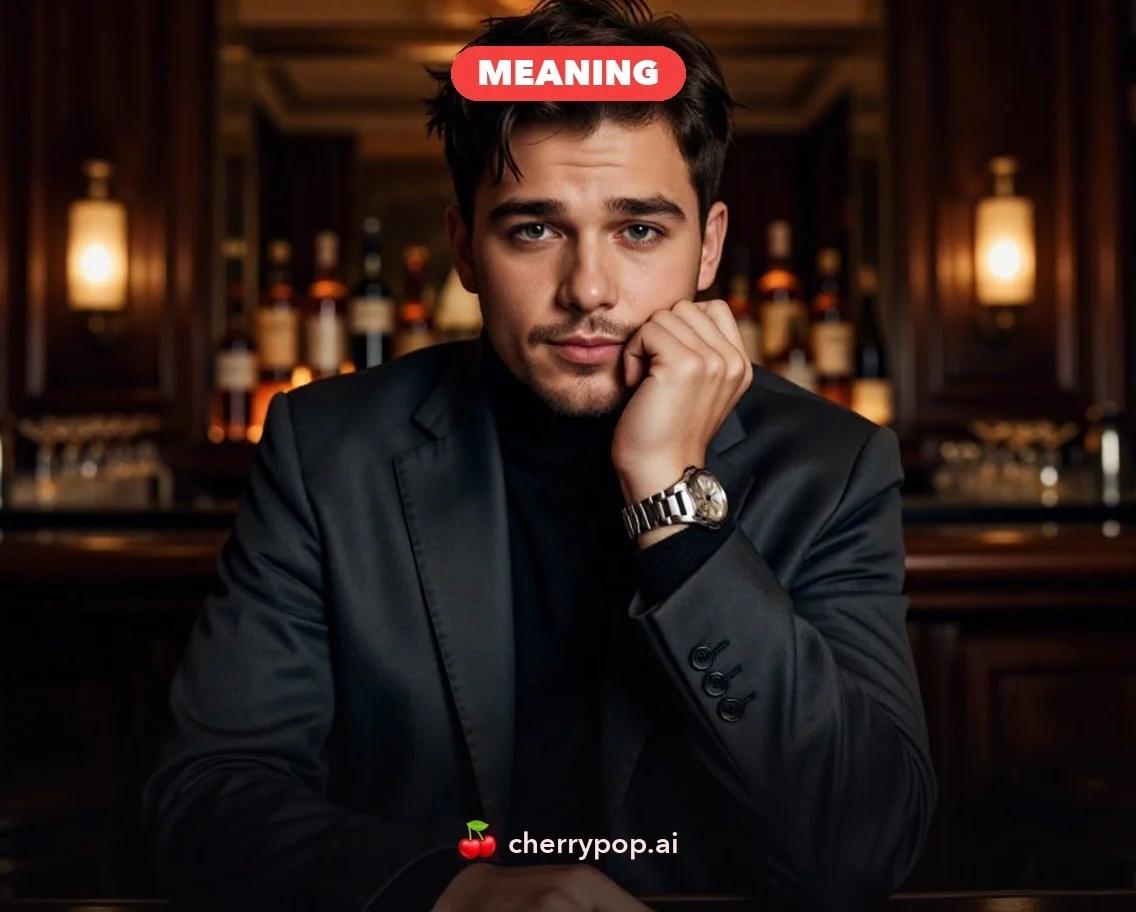
“Tall, dark and handsome” is a stock phrase for an attractive man: above average height, with dark hair (and often dark eyes or a tanned complexion), and good-looking. Behind the three adjectives sits a whole character type. The tall, dark and handsome man of romance fiction is usually reserved, a little mysterious and harder to read than everyone around him, with a warmer side he shows to very few people.
Below: what each word means, where the phrase comes from (it is older than you think), related types, famous examples and how to write one.
Tall, dark and handsome meaning, word by word
- Tall. Taller than average, with presence. Height does a lot of the work here: anthropologist Carolyn Fluehr-Lobban has pointed out that “short, dark and handsome” would not carry the same appeal.
- Dark. Historically this meant dark hair, and often dark eyes. When it referred to skin, it usually meant a tan, which suggested an active outdoor life rather than a pale indoor one. It also picked up a second, figurative meaning: dark as in mysterious, guarded or a little dangerous.
- Handsome. Good-looking in a classic, strong-featured way rather than pretty.
The order never changes. Dictionary editors call this a trinomial, like “cool, calm and collected”: nobody says “handsome, tall and dark.” That fixed rhythm is a big part of why the phrase has lasted so long.
Where the phrase comes from
Short answer: it was in print in the 1800s, became a cliché of popular fiction around 1910, and attached itself to Hollywood leading men from the 1920s.
- 1833. The earliest full-wording example word-watchers have turned up is in “The Story of Hester Malpas” by L.E.L. (the poet Letitia Elizabeth Landon), in The New Monthly Magazine: Hester had “fancied a tall, dark, and handsome face” for the aunt she had never met. Without the “and,” “tall, dark, handsome” appears in a novel as early as 1815.
- 1866. An essay in Once a Week mocking lonely-hearts ads quotes one in which a woman describes herself as “tall, dark and handsome.” Until the early 20th century the phrase was used for women as well as men.
- 1882. Quotation scholar Fred Shapiro traced the exact wording in newspaper archives to 1882.
- Around 1910. The British lexicographer Eric Partridge, in his Dictionary of Catch Phrases, tied the phrase’s popularity to cheap romantic novels of the period. As the writer Alan Axelrod reads Partridge, that made it a little mocking from the start: a cliché lifted from the kind of fiction that described every hero the same way.
- 1920s. Hollywood commonly applied it to Rudolph Valentino, who, in the words of one reference book on American phrases, “created the model of the ‘thrilling dark hero'” for later leading men.
- 1941. Twentieth Century Fox released Tall, Dark and Handsome, a comedy with Cesar Romero as a Chicago mob boss with a soft heart. The film was nominated for the Academy Award for Best Original Screenplay.
What about Cary Grant?
You will often read that Mae West coined the phrase about Cary Grant in She Done Him Wrong (1933). The real story is a bit different. Nobody in the film says “tall.” West’s character, Lady Lou, calls another suitor, Serge (Gilbert Roland), “warm, dark and handsome,” and in the final scene she calls Grant’s Captain Cummings simply “dark and handsome.” The line stuck to Grant: a November 1934 Vanity Fair profile of him ran under the headline “Warm, dark and handsome” and credited West’s delivery with making him a star. With his dark hair and near-permanent suntan, Grant became the phrase’s unofficial mascot anyway.
The tall, dark and handsome archetype in romance fiction
In fiction, the phrase is a shorthand for a specific kind of hero. The looks come as a package with a personality:
- Reserved. He says less than everyone else in the room, and what he says counts.
- Mysterious. There is something in his past or his life he does not explain. Pulp mysteries made “the tall, dark, handsome stranger” a stock figure for exactly this reason: nobody knows who he is.
- Aloof on the surface, caring underneath. The cool manner hides a protective, loyal side, and the story is about getting past the first to reach the second.
- Competent. He is good at something that matters: running an estate, a company, a mission.
That arc, the cold first impression that turns out to be wrong, is the engine of a lot of classic romance, and it overlaps with tropes like enemies to lovers and grumpy/sunshine (see our romance tropes list for the rest).
Related types: brooding hero, Byronic hero and others
“Tall, dark and handsome” describes how a man looks. The related archetypes describe who he is, which is why a character can be one without the other.
| Type | Defined by | Core trait | Classic example |
|---|---|---|---|
| Tall, dark and handsome | Looks (plus an implied cool manner) | Magnetic, reserved, a bit mysterious | Mr. Darcy |
| Brooding hero | Mood | Guarded, carries a past he will not talk about | Bruce Wayne |
| Byronic hero | Moral darkness | Proud, moody, rebellious, capable of deep feeling | Mr. Rochester |
| Himbo | Looks plus a sweet, simple nature | Kind, earnest, not very bright | Joey Tribbiani |
The Byronic hero is named after the poet Lord Byron, whose gloomy heroes (and public persona) defined the type in the 1810s. The historian Lord Macaulay summed him up as “a man proud, moody, cynical, with defiance on his brow, and misery in his heart… yet capable of deep and strong affection.” Readers assumed Byron was his own brooding hero, and his portraits helped, which is partly why the two types get blended.
Mr. Rochester from Jane Eyre (1847) shows the difference neatly. He is a textbook Byronic hero, but Jane describes him as “of middle height,” with “a dark face, with stern features and a heavy brow,” around 35 years old. When he asks her whether she thinks him handsome, she answers, “No, sir.” Dark, yes; tall and handsome, not according to the book.
The himbo is close to the opposite: the same good looks, but open, uncomplicated and sweet. If you want the full breakdown of that type, see our guide to the himbo meaning. For the wider family of recurring characters, see our character archetypes list.
Famous tall, dark and handsome characters
Mr. Darcy (Pride and Prejudice, 1813)
The template for the aloof romantic hero. At the Meryton ball, Austen has him draw attention “by his fine, tall person, handsome features, noble mien,” and the room decides he is much handsomer than Mr. Bingley, until his manners turn it against him. He is about 28. The novel never actually calls him dark: that part comes from decades of dark-haired screen Darcys.
James Bond (Ian Fleming’s novels)
Fleming’s Bond is 183 cm (about 6 feet), with black hair, a comma of which falls over his forehead, and what the books call “dark, rather cruel good looks.” One character compares him to the musician Hoagy Carmichael, “but there was something a bit cruel in the mouth, and the eyes were cold.”
Bruce Wayne (Batman)
A dark-haired billionaire by day and a vigilante by night, Bruce Wayne combines the tall, dark and handsome look with the brooding hero’s inner life. Writers on the Byronic hero have linked Nolan’s version to that tradition, and Christopher Nolan described Christian Bale’s version as “exactly the balance of darkness and light that we were looking for.”
Don Draper (Mad Men)
The charismatic, enigmatic creative director of a 1960s Manhattan ad agency, living under an identity that is not his own. As romance novelist Amelia Wilde put it when explaining why the hero needs to be dark: “Imagine a blond Don Draper. It just doesn’t work.”
Why the type appeals
- Mystery is a hook. A character who does not explain himself makes you want to find out more.
- The soft center. The payoff is the moment the cool exterior drops for one person. Being the exception is the fantasy.
- Quiet confidence. He does not need to prove anything, and that calm reads as strength.
Is it a universal standard of attraction? The science is less tidy than the cliché. Asked in 2017, Penn State anthropologist David Puts said there was not enough cross-cultural research to be confident. Tastes also vary by place: in India, for example, advertising has tended to swap “dark” for “fair.” One 2023 book on height goes further and argues that of the three words, only “handsome” is consistently wanted.
How to write a tall, dark and handsome character
The looks are the easy part. What makes the type work is the gap between how he seems and who he is.
- Show, do not list. Instead of “he was tall, dark and handsome,” let other characters react: someone has to look up to meet his eyes, the room goes quiet when he walks in.
- Give “dark” a meaning. Decide what he is guarded about: a loss, a secret, a job he cannot talk about. It does not have to be tragic, just real.
- Plan the thaw. Map the small moments where the warmth leaks out: he remembers a detail, he waits in the rain, he laughs once and looks surprised at himself.
- Keep aloof separate from cruel. Reserved is attractive; contempt is not. Give him a line he never crosses, and let him respect a “no” instantly.
An opening line that sets the tone: “You’re standing in my seat. No, stay. I wasn’t going to use it anyway.” Cool on the surface, a small kindness underneath.
You can also try the type in an AI chat. On Cherrypop.ai’s character creator, put his setup in the Scenario field (for example, the quiet architect who just moved into the apartment across the hall), a line like the one above in First Message, and his traits in Additional Personality Details (“reserved, dry humor, protective, slow to open up, never cruel”). Specific details keep him in character. Our guide on how to AI roleplay goes deeper on prompts, and the AI boyfriend app guide covers companion characters in general.
Tall, dark and handsome FAQ
What does the expression “tall, dark and handsome” mean?
It describes an attractive man who is taller than average, has dark hair (and often dark eyes or a tan) and is good-looking. In fiction it usually also implies a reserved, slightly mysterious personality.
How do you describe a tall, dark and handsome man?
Focus on presence rather than measurements: the height that makes people look up, dark hair and eyes, strong features, a calm, contained manner. Words that fit: striking, imposing, brooding, composed, magnetic.
What is the female equivalent of tall, dark and handsome?
There is no single fixed phrase. Ironically, two of the earliest printed uses of “tall, dark and handsome” described women, so it works for anyone. For the look and mystique, people reach for “statuesque,” “a raven-haired beauty” or “femme fatale,” and TV Tropes files the counterpart under “Aloof Dark-Haired Girl.”
What does “high, wide and handsome” mean?
It is a different American idiom meaning in a carefree, confident, stylish way, as in a horse going “high, wide and handsome” down the road. It has nothing to do with appearance. It has been in print in this sense since at least 1905 and spread through a well-known 1923 car advert.
Is “tall, dark and handsome” a compliment?
Usually, yes, though it is a cliché, so it can sound tongue-in-cheek. According to Alan Axelrod, Eric Partridge considered it faintly ironic from the start, because it came from formulaic romance novels.
Create your own tall, dark and handsome character
Want a reserved, dark-haired companion who opens up slowly? Create your own tall, dark and handsome character on Cherrypop.ai. You choose his look, write his scenario and opening line, and it is free to start, with limits (18+).