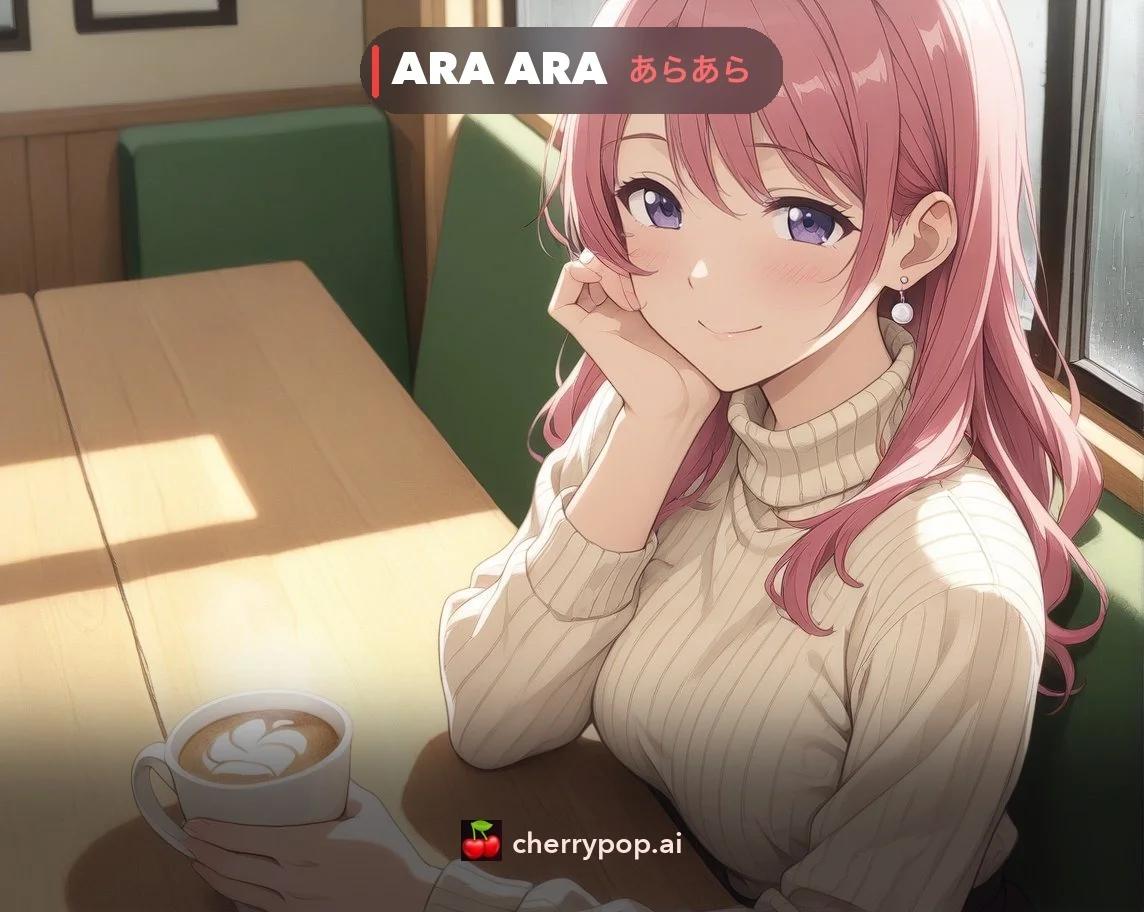
“Ara ara” (あらあら) is a Japanese interjection that means roughly “oh my”, “my, my” or “oh dear”, said when something surprises or moves you, and Japanese dictionaries note that women use it most. In anime, ara ara has become the signature line of the onee-san: the calm, amused, slightly teasing woman who always seems one step ahead of everyone in the room. Here is what the phrase really means, how it sounds, why fans love it, and how to write the archetype yourself.
What does ara ara mean?
Ara ara is simply the word ara (あら) said twice. The Japanese dictionary Digital Daijisen defines it as an interjection “made by repeating ara”, uttered when you are moved or surprised, and adds that it is “mostly used by women”. The larger Nihon Kokugo Daijiten describes it as a word you say when surprised by something unexpected, used “mainly by women in modern times”.
The closest English equivalents are “oh my”, “my, my”, “well, well” or “oh dear”. Jisho, the popular Japanese-English dictionary, glosses it as “tsk tsk; oh-oh; huh; what’s that?”, an expression of mild surprise, incredulity or annoyance.
The word is old. The Nihon Kokugo Daijiten cites ara ara in The Tale of Ochikubo (late 10th century, though some read that line differently) and in the Uji Shūi Monogatari (around 1221). Single ara was used by men and women alike for centuries; the same dictionary notes that it settled into a women’s interjection only in the modern era.
How to say it, and what tone it carries
In standard Tokyo Japanese the pitch drops after the first syllable: Á-ra-a-ra, high on the first “a”, then low. It is four short beats, not “ah-rah ah-rah” with two stresses.
The meaning lives in the delivery. The same two words can sound:
- Surprised: “Ara ara, it’s already raining?” (Oh my, it’s raining already?)
- Sympathetic: “Ara ara, you’ve had a long day.” (Oh dear, rough day, huh?)
- Amused: “Ara ara, you forgot your keys again?” (My, my. Again?)
- Knowing: a slow “ara ara~” with a smile, which says “I see exactly what you’re doing”.
In everyday Japanese it is simply a soft exclamation of surprise or concern, marked in dictionaries as mostly women’s speech. It is not a pickup line.
Ara ara in anime: the onee-san archetype
Onee-san (お姉さん) literally means “older sister”, but Japanese also uses it to address a woman politely, much like “miss”. In anime, the word names a character type: the onee-san.
Her core traits are easy to spot:
- Unflappable. Chaos breaks out and she smiles.
- Playfully teasing. She notices what you’re hiding and lets you know, gently.
- Caring underneath. The teasing is affection; she is the one who shows up when things go wrong.
- Experienced. She has seen this before, and her calm comes from competence.
- Soft speech. Polite forms, a low voice, a little laugh (“fufu”) and, of course, “ara ara”.
Ara ara suits her because it signals surprise without losing composure. A flustered character shouts; the onee-san says “ara ara” and raises an eyebrow. Like the dere labels in our types of dere guide, onee-san describes attitude more than plot role, and it pairs well with other types: an onee-san can be as cool as a kuudere or as openly warm as a deredere.
Outside Japan, the phrase took on a life of its own. Anime fans began using it as a joke reaction on forums in the late 2000s, and from the mid-2010s it became fandom shorthand for the onee-san. That fandom use, not the dictionary, is where its teasing reputation comes from.
Famous onee-san characters
Alicia Florence is the one with “ara ara” as her catchphrase; the others show the range of the type, from gentle to dangerous. (Which traits each one shows is our reading of the character.)
Alicia Florence (Aria)
The textbook case. Alicia, 19 at the start of the series, is a Prima Undine (a gondolier guide) known as “Snow White”, the most popular Undine in her city of Neo-Venezia. In the manga, “ara ara” is her favorite phrase, and she giggles and teases, most of all her childhood friend Akira, a fellow Prima. She is the gentle end of the scale: relaxed, warm, quietly teasing.
Nico Robin (One Piece)
Robin was 28 when she joined the Straw Hat Pirates (30 after the time skip). The crew’s archaeologist is calm to the point of eerie and answers panic with a dry, darkly funny remark and a small smile. She is the composed end of the scale: nothing rattles her.
Retsu Unohana (Bleach)
Captain of Squad Four and one of the founding members of the Gotei Thirteen, Unohana has a serene, soft-spoken, maternal persona and uses honorifics with everyone. Her presence alone is enough to keep patients in their beds until they heal. The twist: that gentleness is a persona she adopted, laid over a past as the Soul Society’s most notorious criminal, a swordfighter who lived for battle. She is the onee-san with a blade behind her back.
Yae Miko (Genshin Impact)
The Guuji (head priestess) of the Grand Narukami Shrine and editor-in-chief of the Yae Publishing House, Yae Miko is a clever kitsune who enjoys running rings around everyone. She is the mischievous version of the type: amused, sharp-tongued and always holding one more card than you think.
Kafka (Honkai: Star Rail)
A soft-spoken woman who cannot feel fear, Kafka meets every crisis with the same unhurried calm. One Japanese gaming headline summed her up as the onee-san in a black coat, and she became one of the game’s most popular characters. She is the mysterious end of the scale: you never quite know what she knows.
Related terms
- Ara ara~: the tilde marks a drawn-out, sing-song delivery. In fan writing it signals the teasing onee-san tone rather than plain surprise.
- Ara (あら) and arara (あらら): the single and slightly different repeated forms, with the same “oh!” meaning. Ara maa (あらまあ) is a close cousin.
- Oya oya (おやおや): “well, well!”, for mild surprise, disappointment or exasperation. Its dictionary entry, unlike ara ara’s, carries no note about women’s speech.
- Fufu (ふふ): a soft, closed-mouth laugh. The onee-san’s second-favorite sound, often right after “ara ara”.
- Maa maa (まあまあ): “now, now”, said to calm someone down.
- Onee-san, onee-chan, onee-sama: the same “older sister” word with different honorifics. -chan is affectionate, -san polite, -sama admiring or formal.
How to write an onee-san character
Whether you are writing fiction or building a character to roleplay with, the onee-san lives or dies on restraint. A few rules that work:
- Give her a reason to be calm. Competence, experience or a past she has survived. Unohana’s serenity lands because of what it hides.
- Tease with observation, not insults. She points out what the other person is trying to hide (“You rehearsed that, didn’t you?”) and lets them stew for a moment.
- Ration the catchphrase. One “ara ara” at the right moment beats one per line.
- Show the care. Every few scenes, drop the act: she remembers the thing you mentioned, she shows up when it matters.
- Let her be surprised for real, once. The best onee-san moment is when someone finally catches her off guard and the smile slips.
- Keep it between equals. She is a few years ahead, not a different life stage: a senior colleague, the bar owner who knows everyone, the neighbor who always has advice.
A sample line: “Ara ara, you came all the way here in the rain just to tell me that? Sit down. I’ll make tea, and then you can tell me what you actually came to say.”
For more on building a character from a type, see our character archetypes guide.
FAQ
What does ara ara mean in English?
“Oh my”, “my, my”, “well, well” or “oh dear”. It is an interjection of surprise or feeling, used mostly by women in modern Japanese.
Is saying “ara ara” flirtatious?
Not in Japanese. There it is an ordinary exclamation of surprise or feeling, and a Japanese speaker would hear exactly that. The teasing reading is a fandom joke from English-speaking anime communities, where “ara ara~” became shorthand for the onee-san. If you say it to a Japanese friend, expect them to hear “oh my”.
Is there a male version of ara ara?
The closest is oya oya (おやおや), “well, well”. Japanese dictionaries list it as a synonym of ara ara, and, unlike ara ara, its dictionary entry carries no women’s-speech note. It carries the same amused “look at this” feel when said slowly.
Why is ara ara so popular?
It is short, easy to say and instantly recognizable, and it packs a whole character into two words: calm, amused, in control. Characters like Alicia Florence made it a catchphrase, and fans adopted it as shorthand for the whole onee-san type.
What does onee-san mean?
Literally “older sister”, used politely for your own or someone else’s older sister, and also to address a woman politely, like “miss”. In anime it names a character type: calm, teasing and caring underneath.
Create your own onee-san character
Like the type? Create your own onee-san character on Cherrypop.ai (18+). Put her calm, her teasing and the moment the mask slips into the Scenario, First Message and Additional Personality Details fields, and see how she plays in conversation. It is free to start, with limits.