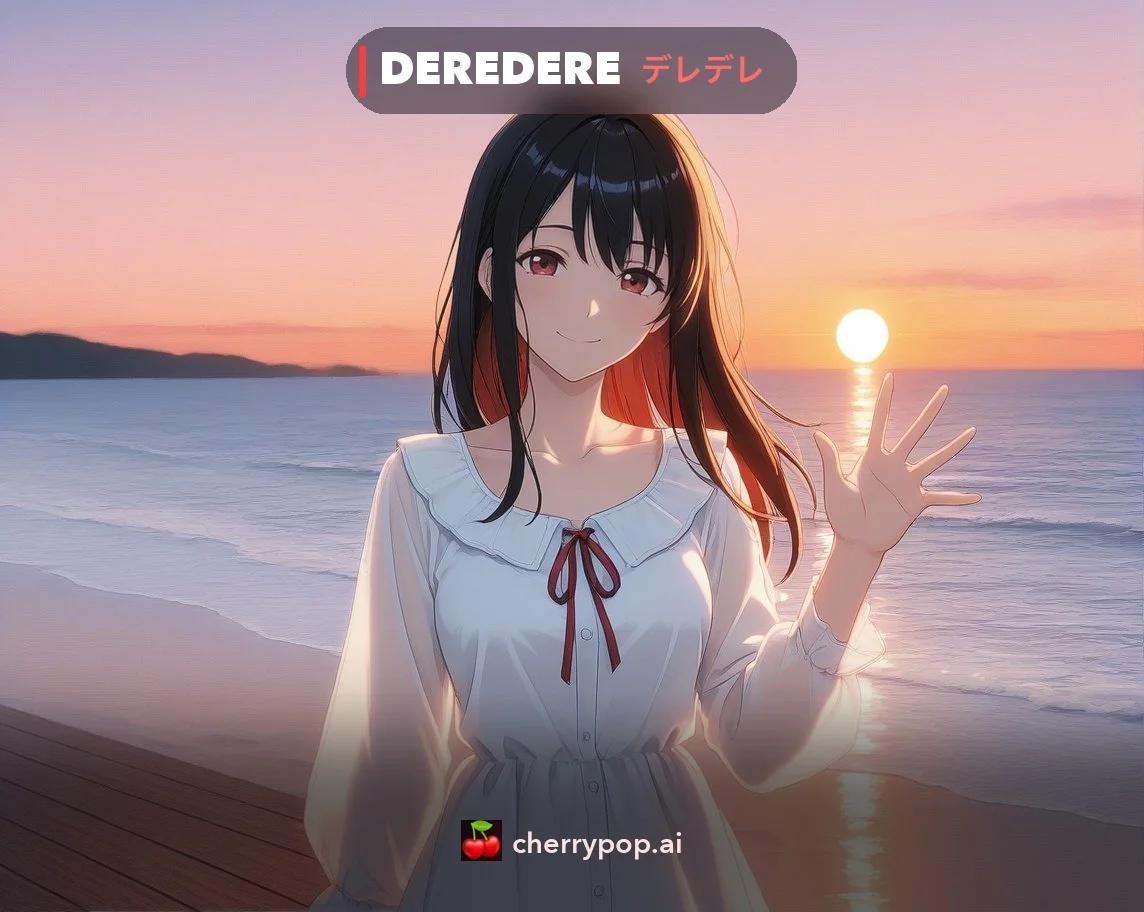
A deredere is a character who is openly, cheerfully in love from the very start: warm, affectionate and happy to show it, with no cold or prickly side hiding their feelings. That is the deredere meaning in one line. The word is Japanese, it became a character label in anime and manga fandom, and it is the simplest of the dere types, the one every other type is measured against.
Below: what “deredere” means in Japanese, where the label came from, the traits that mark a deredere, famous examples, how it differs from a yandere and the other types, and why so many people love this kind of character.
Deredere meaning: the quick definition
Deredere (デレデレ, pronounced “deh-reh-deh-reh”) describes someone who is lovestruck and does not hide it. A deredere character adores the person they love, says so, and acts on it: praising them, staying close, making plans around them, getting visibly happy whenever they walk in.
What makes deredere different from every other dere type is what is missing. A tsundere hides love behind pride, a kuudere behind calm, a dandere behind shyness. A deredere has no second side. They are “dere” at the beginning of the story and “dere” at the end, which is exactly why the word is just “dere” twice.
What does deredere mean in Japanese?
In everyday Japanese, deredere is an ordinary mimetic word, the kind that describes a manner or feeling through sound, and it is much older than anime. It is usually glossed in English as “in a lovey-dovey or infatuated manner, fawningly.”
The Japanese dictionary definitions are a little less flattering than the fandom meaning:
- Nihon Kokugo Daijiten (Japan’s largest dictionary): a slack, unbuttoned manner, especially being sloppy, restless or fawning in front of someone you are attracted to. Its entry cites an example from 1889, in a rakugo (comic storytelling) piece by San’yūtei En’yū III.
- Digital Daijisen: loose, sloppy behavior or posture, and also a man going slack and besotted around a woman.
So in plain Japanese, calling someone deredere can mean they have gone a bit soppy over someone, the way English speakers say “he’s gone all gooey” or “she’s head over heels.” Fandom kept the affection and dropped most of the teasing.
How deredere became a character type
The character-type meaning came second, and it came from tsundere. Once “tsundere” (tsun tsun + dere dere) caught on in the early 2000s, fans started building new labels by swapping the first half. A character who skipped the “tsun” entirely and was dere from the first scene simply got called deredere.
That history explains a quirk of the dere family. Every other label is “something + dere,” and deredere is the base word itself. In a sense, every other type is a deredere with something in the way. You will also see the informal short form “dere,” and the verb dereru, “to go dere,” as in a tsundere finally “going dere.”
Core deredere traits
Most deredere characters show several of these:
- Feelings in plain sight. Everyone around them can tell who they like. Some confess right away; others take a while, but nobody is ever in doubt.
- Constant praise. They compliment the smallest things: a good idea, a new haircut, a job well done.
- Putting the other person first. Giving them the bigger slice, doing what they want to do, planning surprises just to see them happy.
- Bragging about them. A deredere tells friends and family how great their partner is, and does not care who hears.
- Wanting to be pampered back. The Japanese idea of amae, wanting to lean on someone and be looked after, runs through the type. A deredere will say outright, “I’d be happy if you did this for me.”
- Kindness to everyone. With no front to keep up, they tend to be easygoing, sincere and friendly with the whole cast, not just their love interest.
In visual shorthand, anime often gives a deredere heart-shaped eyes or a happy blush whenever their love interest is around.
Does a deredere have an arc?
Not in the way the other types do. A tsundere’s story is about the wall coming down, and a deredere has no wall. So the tension in a deredere story comes from somewhere else:
- An oblivious love interest who somehow misses feelings that are obvious to everyone else.
- Outside obstacles: rivals, bad timing, distance, danger.
- Their own nerves. Even an open-hearted character can freeze at the big moment.
- The partner’s arc. Very often the deredere is the steady, warm half of a pair, and the story is about the other person learning to love them back as openly.
Writing one? Give them something to want besides the relationship, and a love interest who is slow to catch on. Pure sunshine with nothing pushing back gets flat fast.
Famous deredere examples
Mitsuri Kanroji (Demon Slayer)
Mitsuri, 19, is the Love Hashira, one of the Demon Slayer Corps’ elite swordfighters, and her title says it all. She is emotional, passionate and warm to everyone she fights beside. Her feelings for fellow Hashira Obanai Iguro, 21, are obvious to anyone watching, even though her fear of rejection keeps her from saying the words. Open-hearted from her first scene to her last, she is a favorite example of the type.
Wataru Takagi (Detective Conan)
Takagi is an adult Tokyo police detective who is openly, earnestly smitten with his senior partner, Detective Miwako Sato, two years older. He is kind, honest and easy to read, and the whole department knows how he feels. What slows him down is not pride but his own nerves and a string of comic interruptions, many of them from colleagues who have a crush on her too. He wins her over through sincerity alone, which is the deredere story in a nutshell.
Laguna Loire (Final Fantasy VIII)
In the game’s flashbacks, Laguna is a 27-year-old soldier who dreams of becoming a travel journalist. He is cheerful, generous and completely unguarded, and he falls hard for Julia, the professional pianist at a hotel lounge. His one weakness is that his right leg cramps up when he gets nervous around a beautiful woman, which makes his big approach memorably clumsy. A male deredere with a sense of humor about himself.
Deredere vs yandere and other dere types
Deredere is the open-book corner of the dere family. Here is how it compares. For every type in one place, see our guide to all types of dere.
| Type | How they show love | What stands in the way |
|---|---|---|
| Deredere | Openly, warmly, from the start | Nothing on their side |
| Yandere | Openly, then obsessively | Their own jealousy and fear of loss |
| Tsundere | Denials first, sweetness later | Pride and embarrassment |
| Kuudere | Small, quiet gestures | A calm, guarded front |
| Dandere | Chatty and sweet one-on-one | Shyness |
| Himedere | Expects to be pampered, learns to give back | A princess-sized ego |
What’s the difference between deredere and yandere?
They look alike at first, which is the whole trick of the yandere. Both are openly devoted. The difference is where the love goes. A deredere’s affection stays warm and generous: they want the other person to be happy, including with friends and a life outside the relationship. A yandere’s love turns possessive: jealousy and fear of losing the other person grow into obsession, and in the story that can mean stalking, threats or violence. Many yanderes start out looking like textbook deredere, and the turn is the twist. It is a thriller trope, not a model for real relationships.
Deredere vs tsundere, kuudere and dandere
These three all hide something, and a deredere hides nothing. Put a love letter in front of a tsundere and they will insist it is not for you. A kuudere will hand it over without a flicker of expression. A dandere will not be able to hand it over at all. A deredere will read it out loud.
Deredere vs himedere
Both like attention. A himedere expects it as their due, like royalty, and learns to give love back over time. A deredere gives first and asks to be pampered in return, sweetly rather than as a demand.
Close relatives
- Deretsun – tsundere in reverse: usually sweet, but turns cold when flustered or jealous.
- Dorodere – looks like a cheerful deredere, but hides grudges and murky thoughts underneath.
- Kekkondere – ready to marry their love interest almost immediately.
- Nyandere – a cat-eared character who is affectionate the way a cat is: clingy, playful, all head pats.
Why people love deredere characters
- No guessing games. You never have to decode mixed signals. The affection is right there.
- They make everyone around them happier. A deredere lifts the mood of every scene they are in.
- Comfort. After a long day, a character who is simply glad to see you is a relief, not a puzzle.
- A healthy picture of love. The deredere’s habits (honesty, generosity, security) are ones that work in real relationships too.
Am I a deredere?
Outside anime, people use deredere for someone who is openly affectionate: you say “I love you” first, you brag about your partner, you remember the little things and you are not embarrassed to hold hands in public. If friends tease you for going soft the moment your person texts, the label fits. Among fans it is usually meant as a compliment, though in everyday Japanese it can also be a gentle tease about going soft.
FAQ
What does deredere mean in English?
Roughly “lovey-dovey,” “lovestruck” or “head over heels.” In character terms, it means someone who is openly affectionate toward the person they love from start to finish.
Is there a freaky dere type?
Not an established one. Fan lists include plenty of joke labels, but none of them is a standard type. If you mean “weird” or “chaotic,” the closest are bakadere (goofy and airheaded) and dorodere (a sunny surface with dark thoughts underneath). If you mean “scary,” that is the yandere.
What’s the worst dere?
It depends on what you mean by worst. As a partner, the usual answer is the yandere, because the love turns obsessive and, in the fiction, dangerous. As a story, every type can be done well or badly.
Can a deredere be male?
Yes. The dere labels started mostly with heroines, but fans use them for any gender. Laguna Loire and Wataru Takagi, both above, are male deredere characters.
Create your own deredere
Want a character who is simply happy to see you? On Cherrypop.ai (18+) you can create your own deredere character: choose their personality, set the scenario, write their first message, and chat with them in your browser, no app needed. It is free to start, with limits.