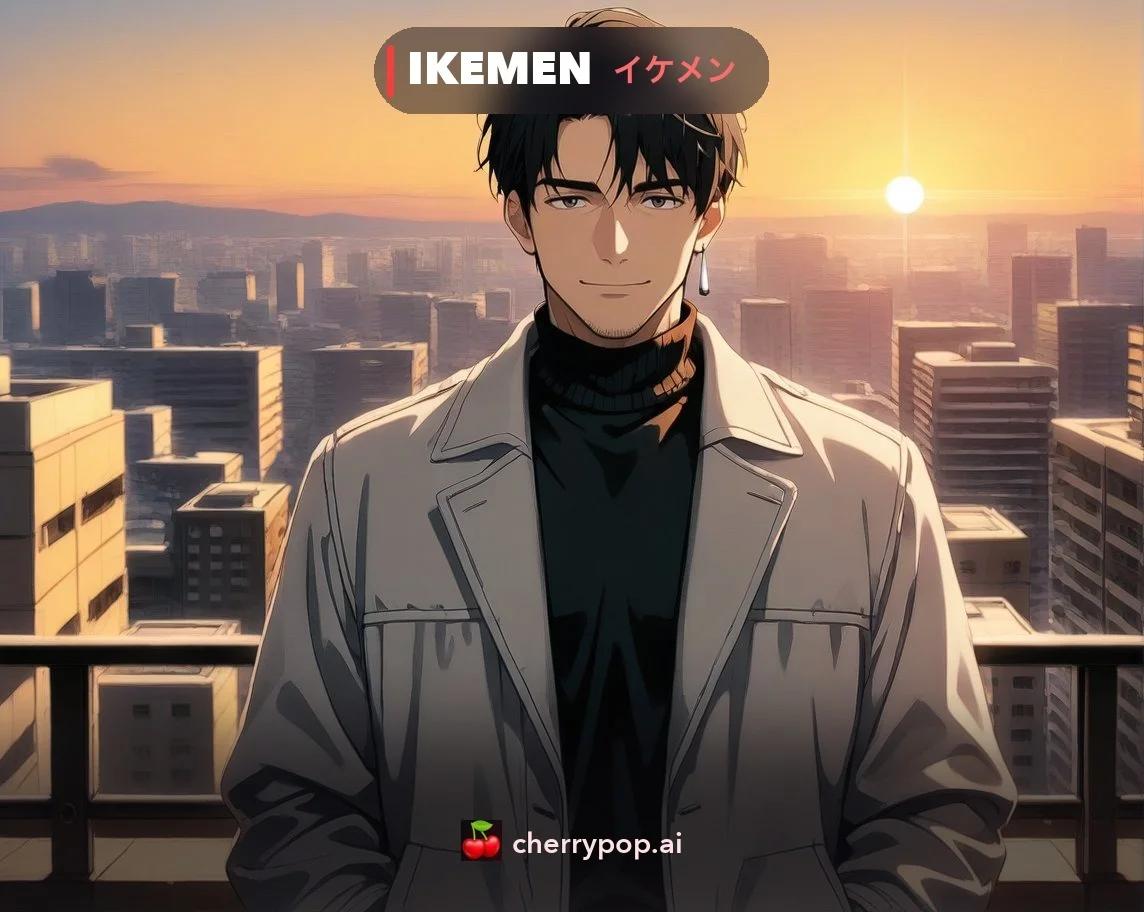
Ikemen (イケメン, pronounced “ee-keh-men”) is Japanese slang for a handsome, good-looking man: someone who is attractive in both face and overall style. That is the ikemen meaning in one line. The word is a compliment, it is used about real men and fictional characters alike, and it has given its name to one of the best-known otome game series, Cybird’s Ikémen games.
Below: the definition, the word’s origin and usage, ikemen vs bishounen vs husbando, the Ikémen games, famous examples, and how to write one.
Ikemen meaning: the dictionary definition
Shogakukan’s Digital Daijisen dictionary defines ikemen as a man who is good-looking in both face and figure, “a cool man.” It lists the word next to older Japanese terms for a handsome man, such as binan (美男), bidanshi (美男子), nimaime (二枚目, the leading-man type) and the English loanword hansamu. English-Japanese dictionaries gloss it as “good-looking guy,” “handsome man,” “hunk” and “cool guy.”
A few quick facts:
- Writing. It is usually written in katakana, イケメン. You will also see イケ面, which mixes katakana with the kanji 面 (“face”).
- Register. It is slang, but mainstream slang: it has been in the Kōjien, the well-known Iwanami dictionary, since its sixth edition in 2008.
Cybird, the company behind the Ikémen games, puts it more playfully on its English site: “A hot guy; the man of your dreams.”
Where the word comes from: iké + men
Ikemen is a blend of two pieces. Ike is short for iketeru (イケてる), casual Japanese for “cool,” “looking good” or “on point.” Men does double duty: the Digital Daijisen explains it as a pun on 面 (men, “face”) and the English word “men.” So an ikemen is, quite literally, a guy with a face that works.
The word’s recorded history is short and well documented:
- Mid-1990s. Phrases like ikeru menzu and iketeru menzu (“cool men”) were already in use in Japanese gay magazines, including G-men in 1996.
- 1999. The women’s fashion magazine egg ran a column by editor Tomoko Yano about attractive men, titled along the lines of “Kurikuri Yano’s Iketeru Men’s.” By the January 1999 issue, the magazine was using “Ikemen” as the column’s short name, and the short form took off, first as the column’s nickname and then as a word for the men it featured. Its brother magazine, Men’s egg, picked it up too.
- 2000. The word entered the annual yearbook of new words Gendai Yōgo no Kiso Chishiki.
- 2008. It was added to the Kōjien dictionary.
The word also spawned a family of spin-offs. Futsumen (フツメン, from futsū, “ordinary”) is an average-looking guy, and busamen (ブサメン, from busaiku, “ugly”) is the opposite of an ikemen. Ikemen boisu (イケメンボイス) means a handsome-sounding voice, a phrase you will hear a lot around anime voice acting.
How people use “ikemen” today
In everyday Japanese, ikemen is simply a compliment. You might hear a friend say “kare, ikemen da ne” (“he’s good-looking, isn’t he”) about a coworker, an actor or a guy in a café. It is warmer and more casual than a formal word like bidanshi, and it is casual enough to use with almost anyone.
Over time the meaning has stretched past looks. Japanese Wikipedia notes that the word is now also read as “a man whose face is cool” in a broader sense: someone who takes care with his hair and clothes and carries himself with style. People also use it for behavior. Japanese has phrases like ikemen na taiō (“handled like an ikemen”) and kokoro ga ikemen (“ikemen at heart”) for a man who does something kind or classy, even if he is not movie-star handsome. The English equivalent is somewhere between “hot guy” and “what a gentleman.”
Ikemen vs bishounen vs husbando
These three words all involve an attractive man, which is why they get mixed up. They answer different questions: ikemen is about how a man looks and carries himself, bishounen is an art style and aesthetic, and husbando is about how a fan feels.
| Term | Literal meaning | What it describes | Used for |
|---|---|---|---|
| Ikemen (イケメン) | “Cool face” / “cool men” | A handsome, stylish man; can also praise his behavior | Real men and fictional characters |
| Bishounen (美少年) | “Beautiful youth” | A delicate, androgynous kind of male beauty: fine features, long lashes, slim build | Mostly an art style in anime, manga and games |
| Husbando | “Husband” with a Japanese-sounding ending (an English fan coinage) | The fictional man a fan is most attached to | Fan slang in English |
Ikemen vs bishounen. Bishounen is an old word with a long cultural history, and it names a specific look: soft, elegant and almost feminine. Ikemen is a 1990s street word, and it is broader. A rugged, broad-shouldered man with stubble can be an ikemen, but he is not a bishounen. Outside Japan, bishounen is mostly used as an art-style label (“drawn in a bishounen style”), while ikemen is closer to “hot guy.” In short: a bishounen look is one kind of ikemen, but most ikemen are not bishounen.
Ikemen vs husbando. A husbando is personal: it is your favorite fictional man, the male counterpart of a waifu. An ikemen is descriptive: any handsome man qualifies, whether you have feelings for him or not. Your husbando is almost always an ikemen in your eyes, but not every ikemen is anyone’s husbando.
The Ikémen otome game series
Outside Japan, many people first meet the word through Cybird’s Ikémen series: free-to-play romance apps in which you play a heroine and choose one man from a large cast to fall in love with. They are otome games in the classic sense, a branching story with a route for each love interest, played on your phone in chapters. Cybird says the series has passed 17 million downloads worldwide, and the apps are available in English, Japanese, Chinese, Korean and Thai.
Each game drops you into a different world full of ikemen. Five of the best-known titles in English, with their Japanese launch years:
- Ikémen Sengoku: Romances Across Time (2015). You fall through time into Japan’s Sengoku period and land among warlords such as Oda Nobunaga and Date Masamune. The English version followed in 2017. In Japan the game later came to PlayStation Vita and Nintendo Switch, and it got an anime adaptation in 2017.
- Ikémen Revolution: Love & Magic in Wonderland (2016). A chase after a man who looks a lot like a white rabbit leads from 19th-century London into a Wonderland split between Red and Black armies.
- Ikémen Vampire: Temptation in the Dark (2017). A trip to the Louvre ends in a mansion of famous men from history, reimagined as vampires, among them Napoleon Bonaparte, Mozart, Leonardo da Vinci and Vincent van Gogh.
- Ikémen Prince: Beauty and Her Beast (2020). You are chosen as “Belle,” and your job is to pick the next king from eight rival princes.
- Ikémen Villains: Wrapped in Wicked Romance (2023 in Japan, March 2024 in English). You witness the crimes of a cursed group called the Crown and end up working alongside nine villains inspired by dark fairy tales.
The brand predates smartphones: Cybird was putting “Ikemen” in its romance game titles on Japanese feature phones by 2010.
The casts share a recipe. Every man is a different flavor of handsome: the arrogant ruler, the gentle one, the prickly tsundere, the cool and distant kuudere, the dangerous one. That spread is the point: the game offers an ikemen for every taste.
Famous ikemen characters
Fans apply the word to any character who is handsome with presence. Here are five that fans often name:
- Levi Ackerman (Attack on Titan). The blunt, obsessively tidy captain whom creator Hajime Isayama has placed in his early thirties.
- Kento Nanami (Jujutsu Kaisen). A sorcerer in his late twenties who used to be an office worker and still dresses the part: tailored suit, tie, zero tolerance for overtime. The “competent, tired man in a good suit” ikemen.
- Spike Spiegel (Cowboy Bebop). A laid-back 27-year-old bounty hunter with a mysterious past.
- Jumin Han (Mystic Messenger). A 27-year-old corporate heir, reserved and very rich, one of the best-known otome leads.
- Sylus (Love and Deepspace). The 28-year-old leader of a criminal organization, in a game that rebuilt the otome love interest in realistic 3D.
They look nothing alike. What makes each one an ikemen is confidence, a clear personal style and a hint of something under the surface. Many also map neatly onto familiar character archetypes: the stoic protector, the reluctant mentor, the charming outlaw.
How to write an ikemen character
Whether you write fiction, run a roleplay or set up an AI companion, “handsome” alone makes a flat character. The ikemen that fans remember combine looks with a few specific choices:
- Give him one signature detail. A suit he never loosens, a scar, a coat, a particular way of standing. Readers remember one sharp image better than a list of good features.
- Pick his flavor. Cool and reserved, warm and teasing, arrogant with a soft spot, dangerous but loyal. Anime’s dere types are a handy menu; our guide to the types of dere lays them out.
- Let his actions do the flirting. In Japanese usage, behavior earns the word as much as looks. Show him keeping his word, noticing small things, staying calm when it matters.
- Add a crack in the surface. The otome formula works because every ikemen has a secret, a wound or a duty that gets in the way. That is what gives his route a story.
- Write his voice. How he talks matters more than how he looks, especially in a chat. Short and dry, formal and polite, or playful: decide, then keep it consistent.
If you want to talk to the character rather than read about him, an AI companion is an otome route that keeps going. On Cherrypop.ai (18+), you can build your own ikemen in the character creator: put the setup in the Scenario field, his opening line in First Message, and his quirks in Additional Personality Details. It runs in your browser, including on mobile, and it is free to start, with limits. For a wider look at the options, see our guide to AI boyfriend apps.
Ikemen FAQ
What does ikemen mean?
Ikemen means a handsome, good-looking man in Japanese slang. It comes from iketeru (“cool”) plus men, a pun on 面 (“face”) and the English word “men.”
Is ikemen a compliment?
Yes. It is a friendly, casual compliment about a man’s looks or style, and it can also praise something cool he did. It is informal, so it suits friends and casual talk more than a business meeting.
What is the difference between bishounen and ikemen?
Bishounen (“beautiful youth”) names a specific delicate, androgynous look and is mostly used for an anime and manga art style. Ikemen is everyday slang for any handsome man, rugged or refined, real or fictional.
What is ikemen for girls?
The everyday word for a beautiful woman is bijin (美人). For a woman who is cool and dashing in the way an ikemen is, Japanese uses ikemen joshi (イケメン女子, also “handsome joshi”). The Jitsuyō Nihongo Hyōgen Jiten, a Japanese usage dictionary, describes her as a woman with qualities usually admired in men, often the kind other women call “cool”: understated clothes, a calm way of speaking and bold decisiveness.
What is Ikemen GO?
Ikemen GO is unrelated to the slang or the romance games. It is an open-source fighting game engine, compatible with M.U.G.E.N content and written in the Go programming language.
Meet an ikemen of your own


Like the sharp-tongued type with a soft side? Talk to Leon, a tsundere. Prefer cool and reserved? Try Alexei, a kuudere. Or create your own ikemen and write his personality from the first line.