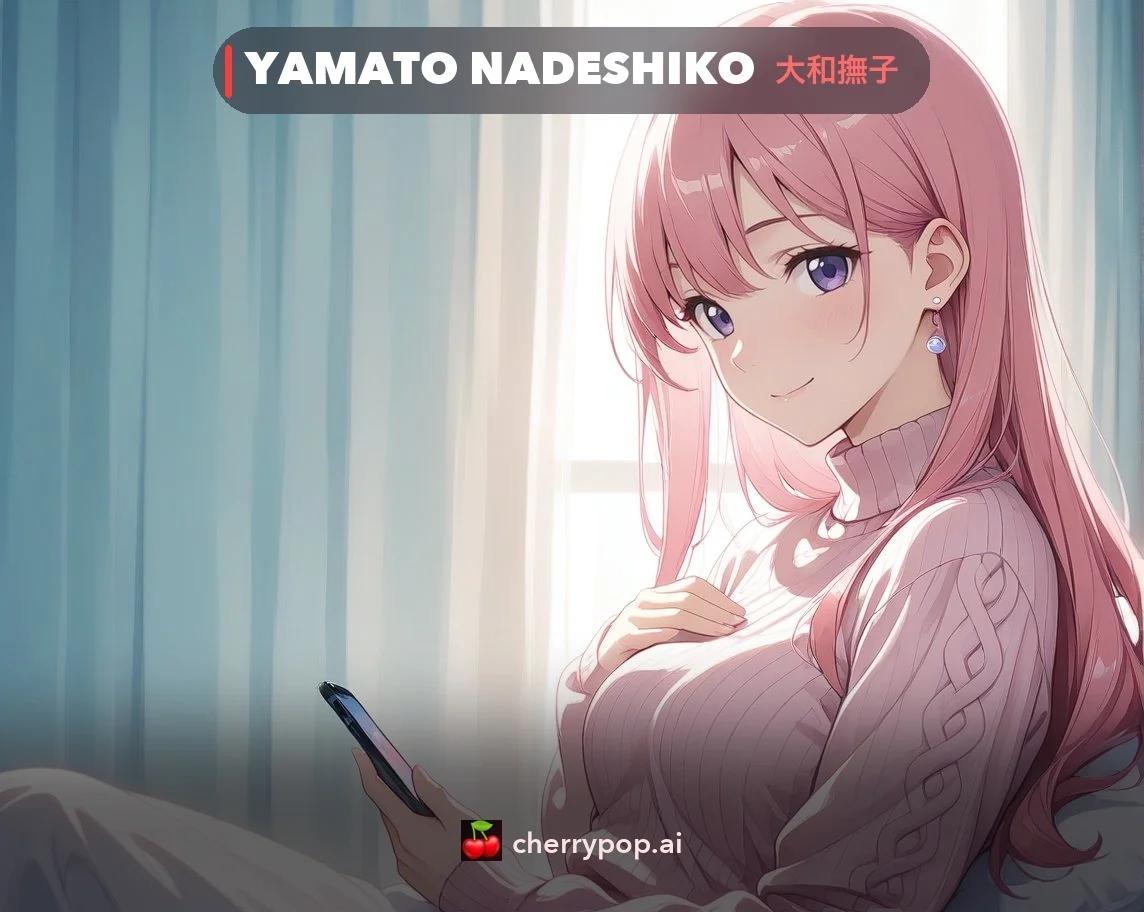
Yamato nadeshiko (大和撫子) is a Japanese term for the idealized traditional Japanese woman: graceful, modest and gentle on the outside, quietly strong and loyal underneath. It joins Yamato, an old name for Japan, with nadeshiko, the frilled pink dianthus flower, so it literally means “Japanese pink”. Today you will meet it in three places: as an old-fashioned compliment, as the nickname of Japan’s women’s football team, and as a classic anime archetype. Here is what it means, where it came from, why some people find it outdated, and how it compares to the ojou-sama and onee-san types.
What does yamato nadeshiko mean?
Japanese dictionaries give it two senses. The Digital Daijisen lists (1) another name for the nadeshiko flower and (2) “a word praising the pure, graceful beauty of Japanese women”. The larger Nihon Kokugo Daijiten gives the same two senses, the second as a term that extols that beauty.
In English it is usually glossed as “the personification of an idealized Japanese woman”. The ideal carries a built-in contrast: delicate, elegant and deferential in public, with a firm, determined core. Think of a woman who never raises her voice but never bends on what matters.
- Yamato (大和): an ancient name for Japan, with a patriotic ring. It appears in other compounds such as Yamato-damashii, “Japanese spirit”.
- Nadeshiko (撫子): the fringed pink, Dianthus superbus. The name comes from the old verb nadu, to caress gently, plus the endearing suffix -ko, so it carries the sense of “darling” or “cherished one”.
Where the name comes from: the nadeshiko flower
Before it described a woman, yamato nadeshiko described a plant. A related pink, the sekichiku, came to Japan from China and was called kara nadeshiko, “Chinese nadeshiko”. The native wild pink was named yamato nadeshiko to set it apart. It is one of the seven flowers of autumn in Japanese tradition, and nadeshiko has been a subject of poetry since the Man’yōshū, Japan’s oldest poetry anthology.
The Nihon Kokugo Daijiten‘s earliest citation for the flower sense is a poem in the Kokin Wakashū (compiled 905-914). For the sense “a Japanese woman”, its earliest citation is much later: the preface of a popular romance novel from 1839-41, which pairs “Yamato nadeshiko” with a Chinese counterpart. So on the dictionary’s evidence, the woman sense turns up centuries after the flower sense, in the late Edo period.
History: how a flower became a national ideal
The word gained its weight in modern Japan, when the state began shaping what women should be. In 1875 the educator Nakamura Masanao coined the phrase ryōsai kenbo, “good wife, wise mother”, and it became official policy for girls’ education in the Meiji era. As historian Shizuko Koyama sets out, it was fixed as the goal of girls’ secondary education by an 1899 ordinance and tied to the idea of the nation as one large family.
The yamato nadeshiko ideal fits that policy closely: the woman who supports her husband, raises the next generation and keeps the home in order. During World War II, ultranationalists promoted the yamato nadeshiko as the female counterpart of Yamato-damashii, the “Japanese spirit” used as a rallying cry for the armed forces.
Critiques, and how the term is used today
That history is why the term is contested. The same governments that promoted “good wife, wise mother” passed laws in 1890 and 1900 barring women from political meetings and organizations, keeping their role inside the home. Koyama argues the ideal was not an old Confucian holdover but a modern ideology that justified a gendered division of labor (“men work while women do housework and raise children”), and that it carried on in postwar Japan and has parallels in Western countries.
Anime writers have picked up the same tension. A 2023 CBR essay calls yamato nadeshiko “an outdated title that encourages the traditional gender role of women”, while noting that newer stories give the type more agency.
The other side is real too. Many people use the word as a warm compliment for grace, good manners and inner strength, with no politics attached, and Japanese lifestyle magazines still run features on how to embody its elegance. A fair summary: it is a sincere compliment to some, a relic of state-made gender roles to others, and which one you hear depends on who says it and why. If you use it, know that it praises a very specific, traditional kind of woman.
Nadeshiko Japan: the national women’s football team
The best-known modern use has nothing to do with housekeeping. In 2004 the Japan Football Association ran a public naming contest for its women’s national team and, from about 2,700 entries, announced “Nadeshiko Japan” on 7 July 2004. The team then won the 2011 FIFA Women’s World Cup, beating the United States on penalties to become the first Asian champions, and took Olympic silver in 2012.
Even here the old meaning follows them. Media scholar Michelle H. S. Ho found that Japanese morning television after the 2011 win swung between treating the players as national heroes and as trivialized “feminine” figures. The nickname shows how the word has stretched: from demure wife to world champion, with the argument about femininity coming along for the ride.
Yamato Nadeshiko, the TV drama
The phrase is also the title of one of Japan’s best-loved romantic comedies. Yamato Nadeshiko aired on Fuji TV’s Monday 9 p.m. slot from 9 October to 18 December 2000, in 11 episodes. Its heroine, Sakurako Jinno, is a flight attendant determined to marry a rich man, who falls for the owner of a small fish shop who walked away from mathematics. The title plays against her: she looks the part of the ideal woman while chasing money. The show averaged a 26.4% household rating in the Kantō region (Video Research) and peaked at 34.2%.
The yamato nadeshiko archetype in anime
In anime and manga, yamato nadeshiko names a character type rather than a policy. Like the labels in our types of dere guide, it describes temperament more than plot role. The usual traits:
- Grace and good manners. Polite speech, calm movement, often long black hair and a kimono or traditional touches.
- Kindness and care. She notices what others need before they ask.
- Domestic skill. Cooking and keeping a household running smoothly.
- Loyalty. Devoted to the people she has chosen.
- A spine of steel. The gentleness hides resolve, and the best-written versions show it at a key moment.
Modern stories tend to keep the grace and rewrite the obedience: the character chooses her path, and her quiet strength becomes the point instead of her deference. That is also what makes her work in romance. She is warm without being loud, and the moment she stands her ground carries weight precisely because she rarely does.
Yamato nadeshiko examples in anime
Miyo is the example critics cite most often. Yor and Unohana are our picks, for how they bend the type.
Miyo Saimori (My Happy Marriage)
The current textbook case. Miyo, 19, is the eldest daughter of the Saimori family in an alternate Taishō-era Japan, treated as a servant by her own family because she seems to have no supernatural gift. She is sent into an arranged marriage with Kiyoka Kudō, the 27-year-old head of the Kudō family and commander of a special military unit. Miyo is kind, modest and endlessly polite, but when her family demands she give him up, she refuses. That refusal is the archetype in one scene: soft on the surface, unbreakable underneath.
Yor Forger (Spy x Family)
The subversion. Yor, 27, works at Berlint City Hall and is formally spoken, soft and considerate, trying hard to be a good wife and mother for the Forgers. She is also a professional assassin known as the Thorn Princess. The joke is that she has every yamato nadeshiko trait except the domestic one: her cooking is, in canon, close to poisonous.
Retsu Unohana (Bleach)
As captain of Squad Four, the healers, Unohana is unfailingly polite, calm in any crisis and quietly firm with patients who try to leave before they are well. Then the story reveals who she was before: a founding captain of the Gotei Thirteen, the first Kenpachi, and once the Soul Society’s most notorious criminal. She is the archetype pushed to its limit: the steel under the silk is literal.
Yamato nadeshiko vs ojou-sama vs onee-san
These three get mixed up because all can be elegant and composed. The difference is where the elegance comes from.
| Type | What the word means | Core of the character | Typical behavior |
|---|---|---|---|
| Yamato nadeshiko | “Japanese pink”, the ideal traditional woman | Virtue: grace, care, quiet strength | Modest, attentive, polite, firm when it counts |
| Ojou-sama | Polite term for someone else’s daughter; “miss” | Status: wealth and a sheltered upbringing | Refined or haughty, formal speech, lost in ordinary life |
| Onee-san | “Older sister”; also a polite way to address a woman | Experience: calm, amused confidence | Teasing, unflappable, looks after others |
Ojou-sama (お嬢様) is an honorific for someone else’s daughter and a polite “miss”. In anime it marks a rich, refined, often sheltered character, sometimes proud to the point of haughtiness. A yamato nadeshiko can be rich, but her appeal is her character, not her family’s money. An ojou-sama who turns sweet on the one she likes is an ojoudere, a close cousin of the himedere. A well-bred ojou-sama can also be a yamato nadeshiko; the labels overlap.
Onee-san is the calm, teasing type most associated with “ara ara”, though a yamato nadeshiko may say it too (see our ara ara meaning guide). Both she and the yamato nadeshiko are composed, but the onee-san leads with playful confidence while the yamato nadeshiko leads with modesty. One teases you; the other quietly makes you tea and says nothing about the mess.
For how these fit alongside other types, see our character archetypes list.
FAQ
What is the meaning of yamato nadeshiko?
It is a term praising the graceful beauty of Japanese women and, by extension, the idealized traditional Japanese woman: gentle and modest outside, strong within. Literally it means “Japanese pink”, after the dianthus flower, which is also its first meaning.
Who is considered the ideal woman in Japan?
Traditionally, the yamato nadeshiko. That ideal was shaped by the “good wife, wise mother” policy of the Meiji era, and many people now see it as outdated or as one ideal among many. Modern Japan has no single agreed ideal, and the word itself has stretched to cover world-champion footballers.
Is calling someone yamato nadeshiko a compliment?
Usually it is meant as one, praising elegance and good character. But it praises a traditional, deferential kind of femininity, so some women hear it as a nudge toward an old role. Context and relationship matter.
Where can I watch Yamato Nadeshiko?
All 11 episodes of the 2000 drama became available on Fuji TV’s FOD service and on Netflix from February 2025. Netflix availability varies by country, so check your region’s catalog.
Is Yamato Nadeshiko finished?
Yes. The drama ran for 11 episodes and ended on 18 December 2000. It has no sequel series. Fuji TV aired a director’s-cut special in April 2001 and a two-part 20th-anniversary special edition in July 2020, both built from the original episodes.
Create your own yamato nadeshiko character
Like the type? Create your own yamato nadeshiko character on Cherrypop.ai (18+). Put her grace, her care and the one thing she will never give up into the Scenario, First Message and Additional Personality Details fields, and see how she plays in conversation. It is free to start, with limits.