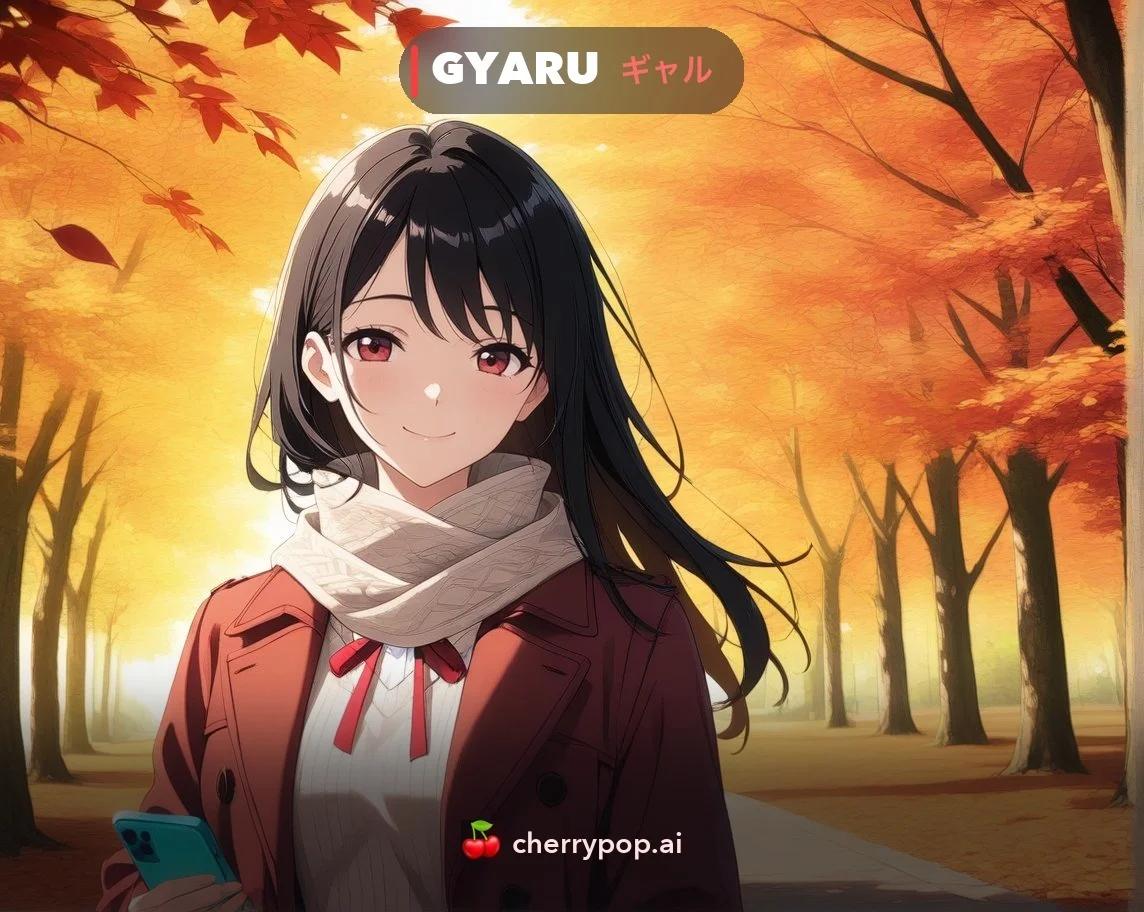
Gyaru (ギャル) is the Japanese word for “gal”, and the name of a Japanese fashion subculture known for dyed hair, dramatic eye makeup, decorated nails and a loud, confident attitude. So the short gyaru meaning is “gal”, but in practice it describes a look and a mindset: bright, sociable, trend-chasing and happy to ignore what polite society expects. Here is where the word comes from, how the style grew into a scene of its own, the main substyles, why it has been controversial, and what anime fans mean when they call a character a gyaru.
What does gyaru mean?
Japanese dictionaries define it in two layers. The Digital Daijisen defines it as a girl or youthful woman, especially one who is bright and sociable and shares a sensibility with others by doing things like adopting the latest fashions. The larger Nihon Kokugo Daijiten traces the word to American slang gal, itself a variant of girl.
Outside Japan, the romanized spelling gyaru is used for the subculture specifically, which keeps it apart from the ordinary English word “gal”. Inside Japan, ギャル covers both: a casual word for a lively, fashionable woman and the name of the style.
Where the word comes from
The word is much older than the fashion. A 1928 Sanseido English-Japanese dictionary already lists gal as slang for girl. In the early Showa era it entered Japanese as a “modern word”, usually spelled ギャール (gyāru), and at first it was a mocking term; the Nihon Kokugo Daijiten cites a 1931 dictionary of modern slang for that sense.
Two later moments helped it stick. Some Japanese dictionaries say it spread when Wrangler released women’s jeans called “Gals” in 1972, though that is one theory rather than settled history. And in 1979, Kenji Sawada’s song “OH! Gal” (OH! ギャル) became a hit. From there, gyaru became a standard label for energetic, fashionable women.
A short history of gyaru culture
The bubble era (late 1980s). Before there was a gyaru “look”, there were gyaru. During Japan’s economic boom, office workers and other women in their twenties went out to Tokyo’s discos in tight bodycon dresses. Phrases like pichi pichi gyaru (“lively gal”) and ike ike gyaru (“cool gal”) had already been around since the early 1980s. In 1990, oyaji gyaru (“old-man gal”), a satirical label for office ladies who partied after work but carried themselves like middle-aged men, won Japan’s buzzword-of-the-year award.
The 1990s boom. After the bubble burst, Shibuya became the center of the scene. Its first mass wave, known as kogal, was a street trend of tanned skin, brown or bleached hair and surfer-inspired clothes. The magazine egg launched in 1995, the Shibuya 109 mall shifted its tenants to gyaru brands, and extreme offshoots followed: ganguro (usually glossed as “very dark”), with a deep artificial tan, and yamanba, named after a white-haired mountain witch of folklore, with white makeup around the eyes and lips.
The 2000s and after. The part of gyaru history that gets less attention is what happened as its first fans got older. It did not disappear. It split into scenes for women in their twenties and beyond, with their own magazines, which the next section covers.
Onee-gyaru, age-jo and gyaru mama
Onee-gyaru (お姉ギャル, “older-sister gyaru”). The term took off around 2000 with the launch of the magazine S Cawaii!. It described gyaru who had moved past the flashy early style and were heading toward onee-kei, the polished “older sister” look of mainstream women’s magazines. Onee-gyaru outfits were simpler and less colorful, with fair skin instead of a tan, but kept gyaru eye makeup: carefully drawn brows and strong liner. From around 2004, many readers moved straight to magazines like CanCam and ViVi, and the label faded by about 2006. The onee-gyaru look is still named as a living substyle today, usually in a softer, simpler form.
Age-jo and the Koakuma Ageha scene. Koakuma Ageha (“little devil ageha”, after the swallowtail butterfly) launched in 2005 as a hime-gyaru (“princess gyaru”) fashion magazine. It was unusual for two reasons. Its core readers were women who worked as hostesses in Japan’s nightlife districts, and most of its models were working hostesses themselves. At its 2008 peak it printed around 400,000 copies an issue. Its style, called ageha-kei, did not require a tan and leaned on glamorous dresses and long decorated nails; followers of the look came to be called agejō. The magazine was unusually candid, running models’ own stories about heartbreak, loneliness and mental health next to the fashion pages. It folded in 2014, came back several times, and has returned in print twice a year since 2021.
Ane Ageha. In 2011 the publisher spun off Ane Ageha (“big sister ageha”), a fashion magazine for women in their late twenties and older.
Gyaru mama. Plenty of gyaru kept the style after having children. I LOVE mama, started in 2008 as a joint special issue of Koakuma Ageha and Happie nuts, was the first magazine made for gyaru mothers.
Gyaru-o. There is a male side too. Gyaru-o (ギャル男, “gal man”) wear high-volume styled hair, tans and flashy clothes, and got their own magazine, men’s egg, in 1999.
Gyaru substyles at a glance
| Substyle | Meaning | Signature look |
|---|---|---|
| Ganguro / kuro gyaru | “Very dark” / “black gyaru” | Deep artificial tan, bleached hair, pale makeup around the eyes |
| Yamanba / manba | After the mountain witch of folklore | Darker tan, white-blonde hair, white makeup, face stickers |
| Shiro gyaru | “White gyaru” | Fair skin, light hair, softer makeup |
| Onee-gyaru | “Older-sister gyaru” | Simple, polished outfits with strong gyaru eye makeup |
| Hime gyaru | “Princess gyaru” | Pink and pastel dresses, lace, bows, huge curled hair |
| Himekaji | “Princess casual” | A cheaper, casual take on hime: florals, ruffles, pink and white |
| Amekaji | “American casual” | Loose layers, letterman jackets, denim, bright colors |
| Ora ora gyaru | Tough-girl gyaru | Tracksuits, denim, a masculine biker-inspired edge |
| Gyaru-o | “Gal man” | The male version: styled hair, tan, flashy clothes |
Many substyle names were coined by magazines rather than by gyaru themselves, and people often move between them.
What makes someone a gyaru?
There is no single uniform. Classic markers include:
- Eyes first: false lashes on top and bottom, liner drawn down into round “droopy” eyes (tareme), and circle lenses to make eyes look bigger.
- Hair: bleached or dyed, often curled and teased into big volume.
- Nails: long, decorated artificial nails.
- Skin: a tan in some substyles, fair skin in others.
- Attitude: what is now often called the “gyaru mind”: confidence, independence and not caring what people think.
That last point is why many gyaru say the style is more about mindset than makeup. You can drop the tan and the extensions and still be a gyaru.
Why is gyaru controversial?
From the start, gyaru was a rebellion against Japanese beauty and social norms: the ideal of pale skin and black hair, and the expectation that women settle quietly into the role of housewife. In that sense it is close to the opposite of the yamato nadeshiko, the modest, graceful traditional ideal. Early on, the subculture was seen as racy and linked with delinquency and frivolity, and the label long carried an image of being cutting-edge in looks but short on manners.
A second debate is about race. Deeply tanned substyles, and especially B-gyaru, which imitated hip-hop fashion and Black hairstyles, have been criticized as cultural appropriation, and in 2022 a ganguro-inspired scene in an animated episode of the game Hatsune Miku: Colorful Stage! was pulled a day after English-speaking viewers called it blackface.
Gyaru vs gal: is there a difference?
Linguistically, no: gyaru is simply how Japanese pronounces “gal”. In use, yes. In English, “gal” is an old-fashioned word for any woman. “Gyaru” points to a specific Japanese subculture with its own makeup, substyles, magazines and slang. English releases often translate ギャル back as “gal” (Gal & Dino is one example), so a “gal” in an anime title usually means a gyaru.
The gyaru character in anime
In anime and manga, “gyaru” is also a character archetype, shorthand for a personality as much as a wardrobe. The typical anime gyaru is:
- Loud, friendly and fearless, quick to hand out nicknames and pull shy characters into her plans.
- Fashion-obsessed, with dyed hair, nails and accessories, and slang that English dubs sometimes render as a Valley Girl voice.
- Kinder than she looks. The core of the appeal is the gap between the flashy surface and a loyal, open-hearted person underneath.
Fans have a name for the most popular version of that gap, the “gyaru who is kind to otaku” (オタクに優しいギャル), which grew into an internet meme in the 2020s. Anime News Network noted in 2025 that gyaru characters had become popular in anime again, well after the real-life style’s peak.
Two examples of the type:
- Kaede (My Roomie Is a Dino / Gal & Dino). A laid-back gyaru in her early twenties who works part-time at a convenience store and ends up sharing her apartment with a dinosaur after a night out. She dreams of training to become a nail artist. The series is a gentle gag comedy, and she is the gyaru archetype at its most easygoing.
- Sachika Amane (Kamen Rider Gavv). From live-action tokusatsu rather than anime, but a clean example of the type: a bright, upbeat 22-year-old gyaru who runs her own odd-jobs company, Hapipare, takes in the hero when he has nowhere to go, and hides her own doubts behind a cheerful front.
The Koakuma Ageha scene also reached games directly. In the Japanese release of Yakuza 3, the hostess-club side mission featured real Koakuma Ageha models recreated as 3D characters, and even an in-game magazine modeled on Koakuma Ageha.
The gyaru sits alongside other anime types built on a contrast between surface and heart. Compare the calm, teasing onee-san of ara ara fame and the wider anime mommy type, the traditional yamato nadeshiko, and the dere types like tsundere and kuudere. For the wider map, see our guide to character archetypes, or what fans mean by a waifu.
Gyaru meaning: frequently asked questions
What does being a gyaru mean?
It means following gyaru fashion (bold eye makeup, styled and dyed hair, decorated nails, trend-led clothes) and, just as much, the attitude behind it: confident, sociable and unbothered by conventional expectations.
Why is gyaru controversial?
It openly rejected Japanese beauty standards and ideas of how women should behave, so the media linked it to delinquency and frivolity. Tanned substyles like ganguro and B-gyaru have also faced criticism as cultural appropriation.
What makes a girl gyaru?
Mostly the eyes (heavy lashes, round droopy liner, circle lenses), big dyed hair, nail art, and a confident, outgoing personality. A tan is optional and depends on the substyle.
Do gyaru still exist in Japan?
Yes, in a changed form. The print boom ended in the 2010s: egg shut down in 2014. It came back online in 2018 and has since published new print issues, and Koakuma Ageha returned in 2021. Today’s Reiwa-era gyaru tend to wear lighter makeup, less tan and simpler hair, mix gyaru with other styles, and share their looks on Instagram and TikTok instead of in magazines.
Is gyaru the same as ganguro?
No. Ganguro is one gyaru substyle, defined by a deep artificial tan. Gyaru is the whole subculture, and many substyles, such as shiro gyaru and hime gyaru, favor fair skin.
Create your own gyaru character
Like the type? Create your own gyaru character on Cherrypop.ai (18+). Give her the look, the slang and the soft heart under the loud surface in the Scenario, First Message and Additional Personality Details fields, pick a realistic or anime style, and see how she plays in conversation. It is free to start, with limits.