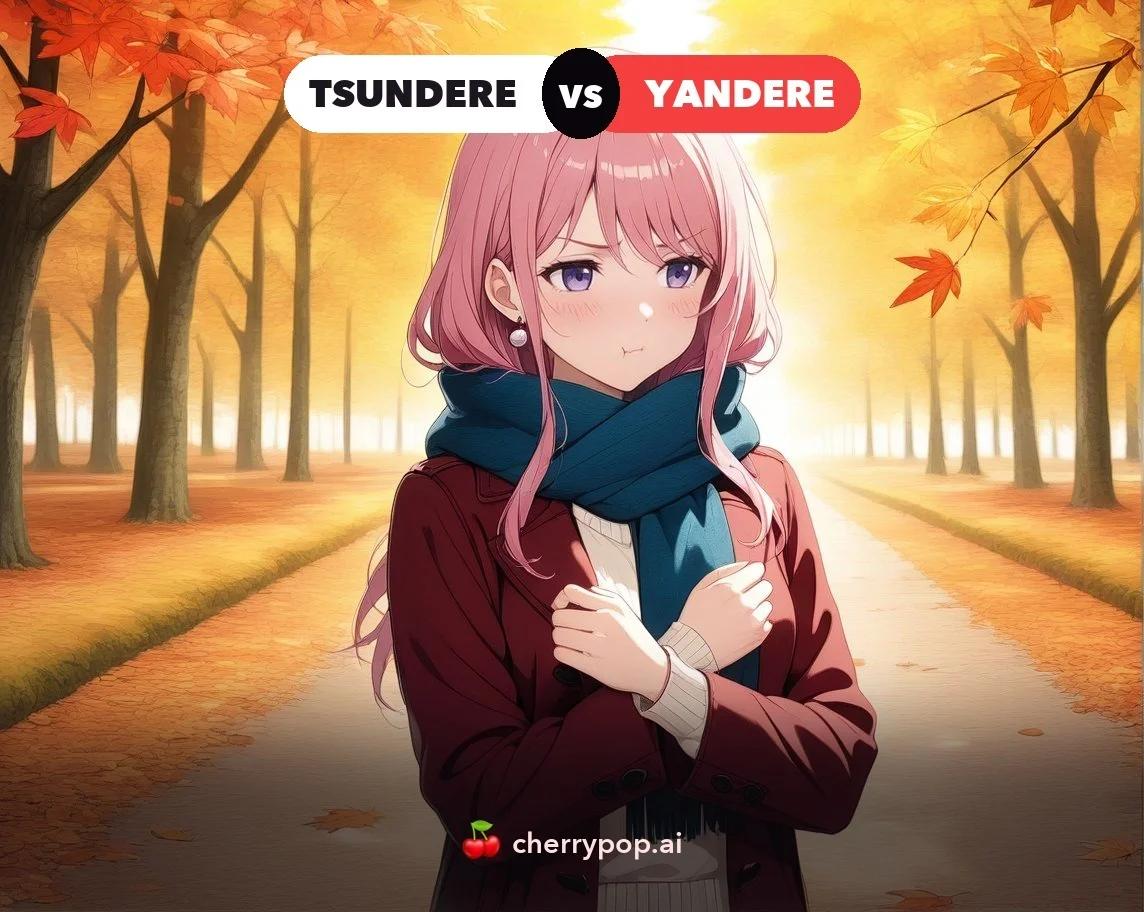
Tsundere vs yandere comes down to direction: a tsundere starts cold and prickly, then warms up, while a yandere starts sweet and devoted, then lets that love turn obsessive and, inside the story, dangerous. A tsundere hides their feelings. A yandere’s feelings take over everything.
Both words are anime and manga “dere” types, and both describe a gap between how a character acts and what they feel. This guide puts them side by side: definitions, a key differences table, how each arc plays out, which one is the healthier story, whether a character can be both, well-known examples, and a short quiz to find out which one you are drawn to.
Tsundere and yandere: the two definitions
A tsundere (ツンデレ) is a character who acts cold, prickly or dismissive toward someone they like, then, over time or in private, shows the warm side they were hiding. The word joins tsun tsun (aloof, turning away in a huff) and dere dere (lovey-dovey). The coldness is a cover: they have feelings they are too proud or too embarrassed to admit. Our tsundere meaning guide covers the full history.
A yandere (ヤンデレ) is a character whose love, often sweet and devoted at first, turns obsessive, possessive and, in the fiction, dangerous. The word joins yanderu (病んでる, “to be sick,” mentally or emotionally) and dere dere. A yandere is lovesick in the most literal way. More in our yandere meaning guide.
The words are related. Tsundere came first: fans coined it on a Japanese forum in 2002 for a visual novel heroine. Yandere was built on the same model and spread around 2005. The Dere Types Wiki sums up the difference as strength and expression: a tsundere has ordinary feelings they cannot say out loud, while a yandere has a pathological love they show without any filter.
Tsundere vs yandere: key differences
| Tsundere | Yandere | |
|---|---|---|
| Literal meaning | tsun tsun (standoffish) + dere dere (lovey-dovey) | yanderu (sick) + dere dere (lovey-dovey) |
| First impression | Cold, proud, snappy | Sweet, attentive, devoted |
| How they handle feelings | Hide them and deny them | Show them fully, with no filter |
| Who gets the hostility | The person they like, as insults, huffy denials and the occasional comic outburst | Rivals first, and in darker stories the person they love |
| Direction of the arc | Cold to warm | Warm to dark |
| What drives them | Pride and embarrassment | Jealousy and fear of being left |
| Typical line | “It’s not like I did this for you or anything!” | “You don’t need anyone else. You have me.” |
| Where you usually meet them | Romantic comedy and action series | Thrillers, horror and dark visual novels |
| How it usually ends | They finally admit it and stay warm | The obsession comes fully into the open |
One question sorts almost any character: what are they hiding? A tsundere hides love behind harshness. A yandere hides nothing about their love; what the story keeps back is how far they will go.
How each arc plays out
Most dere types move from cold to warm. The tsundere is the original version of that arc. The yandere runs it backwards.
The tsundere arc: tsun, almost dere, dere
- Tsun period (tsun-ki). The future love interest gets sharp remarks, eye-rolls and a lot of “whatever.”
- Almost dere (dere-kake). Kindness slips through. They step in to help, then insist it meant nothing: “I just happened to be passing by.”
- Dere period (dere-ki). The denials run out, and the warmth is out in the open, even if only that one person gets to see it.
Plenty of series never leave stage two, since the back-and-forth is what readers come for. Another common version skips the timeline altogether: prickly in front of others, soft when the two of them are alone.
The yandere arc: sweet, crack, spiral, break
- Sweet and devoted. Warm, attentive and completely sincere, easy to mistake for a deredere.
- The first crack. Something small sets it off: an unanswered text, a friendly coworker, a flash of jealousy.
- The spiral. The love gets heavier and the fear of losing it grows. Clinginess becomes watching, and watching becomes control.
- The breaking point. The story’s climax, when nobody can pretend the obsession is normal anymore.
Japanese fans call the turn yami-ka (“becoming sick”). Fans of the genre stress that the appeal is the slow build of tension, not a violent payoff, and in many stories a yandere who feels secure drifts back toward sweetness.
Which one is “healthier” in fiction terms?
The tsundere, clearly. The tsundere story is about someone learning to be honest about their feelings. The payoff is growth: the walls come down, and the character ends up more open than they started. Even the insults are part of a game the audience is in on, because we can see the feelings the character is denying.
The yandere story is about love that stops accepting a no. The strongest versions are written as tragedies or thrillers: the obsession costs everyone involved, including the yandere. It works as fiction because you can close the book. Stalking, checking someone’s phone, cutting them off from friends and threatening rivals are harmful in a real relationship, not a sign of love.
One caution applies to both. In real life you cannot see the hidden feelings the way an audience can. Someone who is consistently cold to you is most likely not interested, and someone who is controlling is not being romantic.
Can a character be both tsundere and yandere?
Yes, but it is unusual, and there is no standard single word for it. Fans usually just write “tsundere-yandere.” The mix looks like this: harsh and dismissive toward the person they like, while behind the scenes they are fiercely possessive and deal with rivals. It is tricky to pull off, because the two types want different endings: one arc ends in honesty, the other in obsession.
Japanese fans occasionally write yantsun (ヤンツン, yandere plus tsundere) for the mix, but it is an informal fan coinage, not a recognized type: the Dere Types Wiki, which catalogs around 70 dere types and variations, has no entry for it. The types of dere guide lists two related types instead: deretsun, a reverse tsundere who is usually sweet but turns cold at certain triggers, and dorodere, who looks cheerful on the surface but hides dark grudges underneath, a cousin of the yandere.
Yandere vs yangire
They share the “yan” (sick) root, which is why people mix them up. A yandere turns dangerous because of love. A yangire snaps because of a trigger, often something from their past, and the outburst has nothing to do with romance. If you take away the obsessive love story, you are looking at a yangire, not a yandere.
Tsundere and yandere examples
Tsunderes
- Vegeta (Dragon Ball). A proud Saiyan prince who acts annoyed by Bulma. When the god Beerus slaps her in Battle of Gods, he explodes in rage, then flatly denies shouting “My Bulma!” once she says it made her feel loved. Over the decades he becomes far more open about loving his family: the full tsun-to-dere arc.
- Hanako Koyanagi and Taro Kabakura (Wotakoi: Love Is Hard for Otaku). Office coworkers, 27 and 28, who bicker constantly, yet both soften the moment the other is hurt, and they later marry.
- Germany (Hetalia: Axis Powers). The example English Wikipedia uses to show the trope is not limited to women: gruff on the outside, caring underneath.
Yanderes
- Misa Amane (Death Note). A 19-year-old model when she enters the manga, she devotes herself completely to Kira, halves her own lifespan twice for a power that helps him, and says she would kill any other woman he dates. Her love is one-sided, and he uses her.
- Harley Quinn (DC Comics). Dr. Harleen Quinzel, a psychiatrist at Arkham Asylum, is manipulated by her patient, the Joker, into becoming his accomplice and lover. The origin frames her devotion as manipulation, not romance.
- Alex Forrest (Fatal Attraction). The villain of the 1987 thriller refuses to accept that a brief affair is over and stalks the man until his family is in danger. The film gave English the phrase “bunny boiler.”
Notice the genres. The tsunderes live in comedies and action series where the relationship is the reward. The yanderes live in thrillers where the relationship is the threat.
Quiz: which one are you drawn to?
Pick the answer that sounds more fun to read or roleplay. Count your A’s and B’s.
- The best scene in a romance is… A: the moment someone finally admits they care. B: the moment you realize how much someone cares, and it is a little too much.
- You like dialogue that is… A: sharp banter and flustered denials. B: soft and sweet, with something unsettling underneath.
- A love interest you have to… A: win over. B: keep an eye on.
- Your favorite genre is… A: romantic comedy. B: psychological thriller.
- The payoff you want is… A: a happy ending that took a while. B: tension that never quite lets go.
Mostly A: you are a tsundere fan. You like the chase and the slow melt, and the reward is earned warmth. Mostly B: you are drawn to the yandere. You like intensity and suspense, the feeling of being someone’s absolute first priority, kept safely on the page. An even split: try a kuudere (calm, unreadable, quietly devoted) or a dandere (shy until comfortable).
FAQ
What is the difference between a yandere and a tsundere?
They are close to opposites. A tsundere starts harsh and turns sweet, hiding real feelings behind pride. A yandere starts sweet and turns obsessive, showing their feelings with no filter until those feelings take over.
What is tsundere, yandere, kuudere and dandere?
Four of the most widely used dere types. Tsundere: cold, then sweet. Yandere: sweet, then dangerous. Kuudere: calm and unreadable, with warmth shown in small ways. Dandere: quiet and shy, talkative and sweet one-on-one. Our types of dere guide covers the rest, including the himedere.
Do yanderes hurt their lovers?
Some do. In many stories the jealousy lands on rivals, and fan wikis even describe a “harmless” yandere with all the clingy love and none of the hostility. But the source the Dere Types Wiki cites for its comparison says a yandere can turn on the person they love as well as the people around them, and darker stories do exactly that, through control, manipulation or captivity. Our yandere girlfriend guide covers how the trope works in romance fiction.
What is nyandere?
A nyandere is the cat version of dere: nyan is how Japanese spells a meow. Picture a cat-eared character who loves like a pet cat, rubbing up for attention, begging for head pats and ending lines with “nya.” Despite the rhyme, it has nothing to do with tsundere or yandere.
Which is more common, tsundere or yandere?
Tsundere is the older word, and most other dere types were modeled on it. It also fits almost any romance or comedy, while a yandere mostly belongs in thrillers and horror, so tsundere characters show up in a much wider range of stories.
Meet a tsundere and a yandere

Took the quiz? Cherrypop.ai (18+) is the best place to meet both types in action. You can chat with Leon, a tsundere, or chat with Kai Nakamura, a yandere, and see the difference for yourself. Or create your own character with exactly the personality you want, from slow-melting tsundere to devoted yandere.